Showing posts with label browsing. Show all posts

Saturday, February 2, 2013

Find: indystate, browsing - safari dominates mobile browsing at 60 %

Internet Explorer still growing as Windows 7 starts its decline
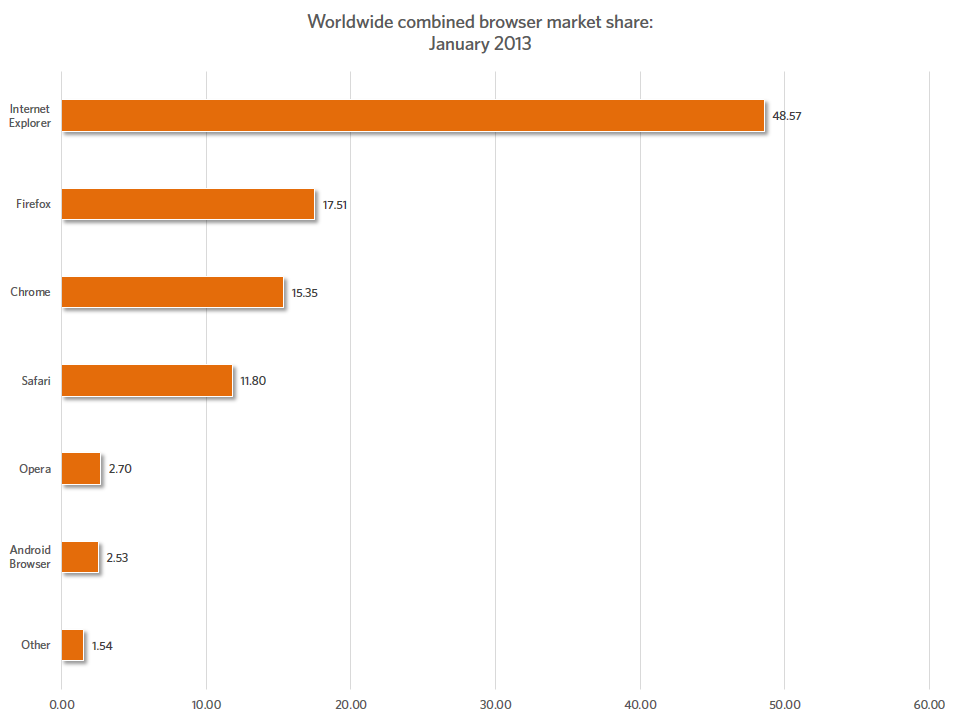
In the first month of 2013, Internet Explorer's desktop market share is continuing to slowly climb upwards, with Firefox consolidating its number two spot. There are signs that Windows 7 may have peaked as Windows 8 is slowly picking up users.

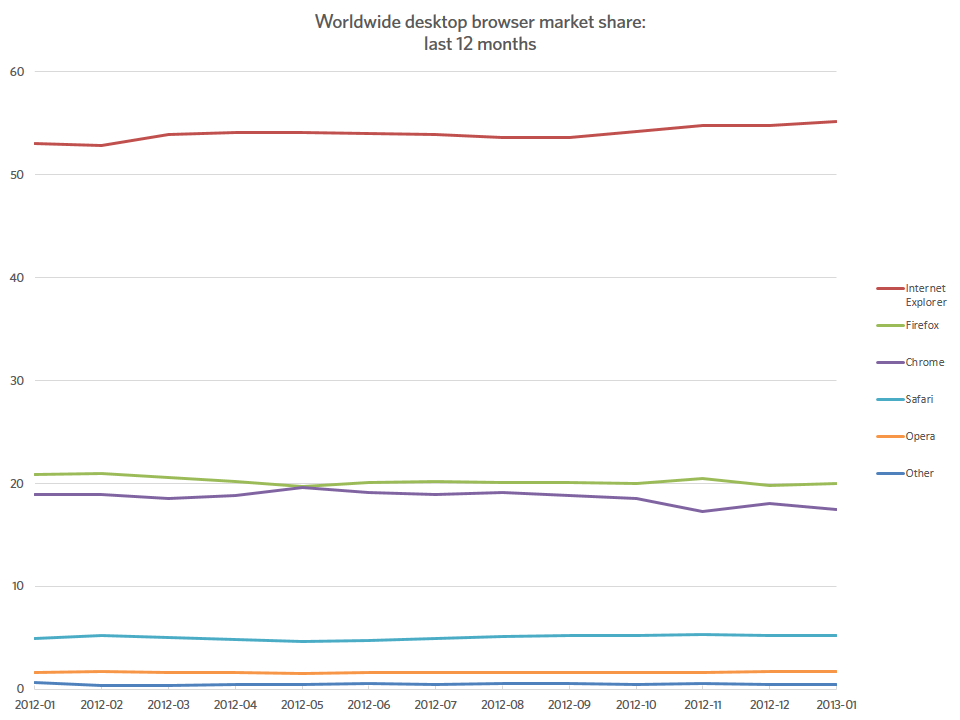
January was a good month for Microsoft's browser, up 0.37 points to 55.14 percent. Firefox also grew, up 0.12 points to 19.94 percent. Chrome fell, down 0.56 points to 17.48 percent. Safari was unchanged at 5.24 percent, and Opera up a hair, gaining 0.04 points to reach 1.75 percent.

The improvement of Internet Explorer's position masks a story that's decidedly mixed for Microsoft. Windows 7 fell for the first time in January, dropping 0.63 points from a high of 45.11 percent to 44.48 percent. Windows 8's slow growth is continuing, up 0.54 points from 1.72 percent to 2.26 percent. There's also a small number of tablet users, with 0.08 percent on Windows 8 Touch and a minuscule 0.02 percent on Windows RT Touch.

Tuesday, August 7, 2012

Spotted: Web use on smartphones -- users revisit sites only 25% of the time

Characterizing web use on smartphones

Chad Tossell, Philip Kortum, Ahmad Rahmati, Clayton Shepard, Lin Zhong

The current paper establishes empirical patterns associated with mobile internet use on smartphones and explores user differences in these behaviors. We apply a naturalistic and longitudinal logs-based approach to collect real usage data from 24 iPhone users in the wild. These data are used to describe smartphone usage and analyze revisitation patterns of web browsers, native applications, and physical locations where phones are used. Among our findings are that web page revisitation through browsers occurred very infrequently (approximately 25% of URLs are revisited by each user), bookmarks were used sparingly, physical traversing patterns mirrored virtual (internet) traversing patterns and users systematically differed in their web use.