Hi folks,
Cameron asked a great question today about the level of access a script hosted elsewhere might have when that script was called through an XSS attack. Is that allowed, he asked, since the script is not hosted on the hacked site?
There is a web security policy called same origin, which is supposed to help prevent these sorts of things. Basically, it prevents a web page from gaining access to data in another web page, unless they are on the same site.
Unfortunately it does not prevent a page at one site from embedding script it hosts in a page at a different site. This is makes XSS attacks just a bit easier, and is a tradeoff we accept for all the non-malicious benefits of embedding.
We also mentioned the dangers of html5 and native client in this context. You can learn more about this in OWASP's video on html5.
Professor Watson
Showing posts with label html5. Show all posts
Showing posts with label html5. Show all posts
Tuesday, December 1, 2015

Monday, September 8, 2014
Assignment: html markup of an online manifesto
Hey folks,
Below is your first coding assignment! It's due by end of day Monday, September 15.
***
Goal:
Constraints:
Validation:
Deliverables:
Below is your first coding assignment! It's due by end of day Monday, September 15.
***
Goal:
- Create a page describing an online manifesto in HTML5 alone.
Constraints:
- Don't use any CSS, or any tags that control appearance (we'll do this later).
- Your page should be contained in one html file.
- Your content should be suitable for use in a classroom context.
Content:
- We suggest that you use the Cluetrain Manifesto (wikipedia), but you are free to use any classroom appropriate manifesto you like.
- Many manifestos are too long for this assignment. Feel free to edit or summarize as you like to make this manageable, but ensure you fill at least one desktop screen.
Validation:
- Validate your page using the W3C Nu Markup Validation Service validator.w3.org/nu/. Address as many of the resulting warnings and errors as you can.
- Test your page on various browsers ("crossbrowser testing") using Browserling, Browsera, BrowserStack or SauceLabs — or any equivalent tool. These make it easy to see how a page is rendered in different browsers without actually running those browsers. Test at least half of the following browsers:
- Firefox for Windows
- Firefox for OS X
- Chrome for Windows
- Chrome for OS X
- Chrome for Android
- Internet Explorer for Windows
- Safari for OS X
- Safari for iOS
Deliverables:
- Using wolfware classic assignment "prog 1", submit the following as a single zip file by end of day Monday September 15:
- Your version of the homepage HTML5 source.
- A text file of 1-2 pages documenting the results of your validation including any remaining errors and warnings, and your summary of the results of crossbrowser testing.
- (Optional) post your impressions of the crossbrowser testing tool you used to our forum for extra credit.
Grading:
- 10% proper turn in
- 10% proper content
- 20% using html5 only
- 20% avoiding CSS and styling
- 20% good validation
- 20% good cross browser testing
Tuesday, January 1, 2013
Find: HTML5 port puts 'Dune II' in your browser
HTML5 port puts 'Dune II' in your browser
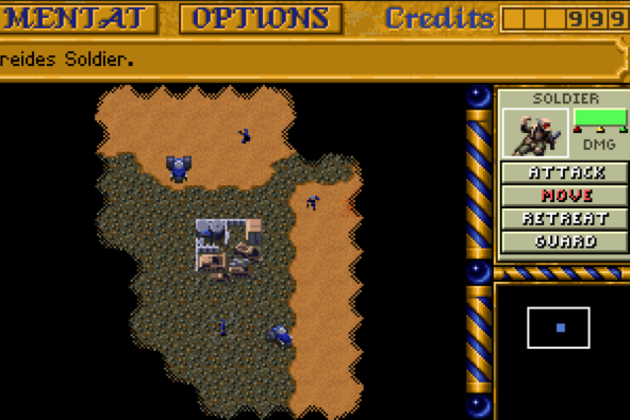
Following in the footsteps of a recent Command & Conquer remake, Russian developer Aleksander Guryanov has created a full HTML5/JavaScript port of the 1992 title Dune II, allowing gamers to enjoy classic real-time strategy (RTS) gameplay in most modern browsers. The implementation is based on the work of the OpenDune project, an effort to create a fully open source version of the seminal game, and is remarkably faithful to the original.
Wednesday, November 28, 2012
Saturday, October 20, 2012
Find: Mozilla focusing on mobile
Update on Firefox Marketplace
Modern browsers based on open standards (like Firefox) enable developers to create amazing Web applications and websites. Mozilla is rapidly increasing the capabilities of the browser platform, which means developers can build more and more of their applications using Web technologies and we’ve been working hard to add more capabilities to the Web as a platform.
We first started working on building these capabilities into the Web and developing our own Firefox Marketplace last year. And, we have seen on the Web and particularly in mobile – Apps, those focused experiences are gaining massive adoption by consumers.
The future is mobile and we’ve made amazing progress with exposing Web APIs across platforms. We’re working to unlock the power of the Web on mobile, just as we did on desktop.
To this end, and based on what we have learned through our efforts to date, we’re now focusing our Marketplace offering. While we previously believed that desktop was the right initial first step to building out an HTML5 app ecosystem, we now believe that we need to pivot further and lead the way with mobile.
We’re not in any way changing our commitment to add features to Desktop as we still feel that Apps are as relevant on desktop as any other environment, but we do need to focus on mobile for the next few releases and as such you won’t see any changes in Desktop for a short period. As soon as mobile has caught up to desktop in features related to Apps we will refocus.
This means:
1) Mobile platforms will be the first target for our HTML5 apps, with desktop to follow providing the means for users to discover and manage their experience;
2) Initial platform targets are Firefox OS and Firefox for Android, with others to follow from our successes there.
We’re happy with the progress we’ve made and excited to share more soon about the next steps for the Web apps ecosystem and Firefox Marketplace. Stay tuned!
Saturday, October 6, 2012
Find: The New York Times launches HTML5 web app for iPad, dodges Apple's in-app subscription fees
Apple is incentivizing the development of html5 as an alternative to the app store's 30% cut.

The New York Times launches HTML5 web app for iPad, dodges Apple's in-app subscription fees
Today, The New York Times announced a new HTML5 web app for the iPad, likely introduced in an attempt to avoid Apple's 30 percent cut of in-app purchases. The Times did state that "subscribers have told us they are interested in trying new ways of reading The Times across a variety of platforms" which may indicate intent to extend the new web app to Android and Windows 8. We've reached out to The New York Times for more information on future development plans. The web app for iPad is currently available to digital subscribers, and can be accessed using Safari.
Update: New York Times corporate communications manager Linda Zebian responded with the following statement:
We developed the app as part of our NYT Everywhere Strategy—which...
Tuesday, October 2, 2012
Find: A behind-the-scenes look at LinkedIn’s mobile engineering
A behind-the-scenes look at LinkedIn’s mobile engineering

Aurich Lawson
LinkedIn is the career-oriented social network that prides itself on professional excellence. But the company's original mobile offering was anything but—it left much to be desired. There was an iPhone application, but no support for Android or tablets. The backend was a rickety Ruby on Rails contraption; afflicted with seemingly insurmountable scalability problems. And despite serving only seven or eight percent of the LinkedIn population, the company's original mobile build required approximately 30 servers in order to operate. This was clearly not made to sustain a growing mobile user base.
Now, a little over a year has passed since LinkedIn relaunched its mobile applications and website. And the company recently marked the anniversary by debuting a number of new mobile features, including real-time notifications and support for accessing company pages from mobile apps.
Mobile is gradually becoming a central part of the LinkedIn landscape. The company says roughly 23 percent of its users access the site through one of its mobile applications, up from ten percent last year. As our friends at Wired reported last month, the underlying design language and development philosophy behind the company’s mobile experience is playing an influential role as the company works to revamp its website.
Thursday, September 27, 2012
Find: 500 Chrome Experiments and counting...
500 Chrome Experiments and counting...
The web is capable of amazing things and is becoming more capable all the time. To show some of the potential of a better web, we launched ChromeExperiments.com in March 2009 with 19 inspiring examples by the creative coding community of what’s possible when combining the latest web technologies with a little code and imagination. Some of those original experiments, like Google Gravity and Ball Pool, are still popular today. But we’re pleased to say that they’ve since been joined by hundreds of other contributions from around that world that have pushed the web even further. Today marks our 500th experiment, and in celebration, we created Experiment 500 as a thank you note to everyone who submitted their work to the site. It’s an array of interactive particles, each one of them corresponding to a different submission. You can sort them by date or by category.
Celebrating 500 Chrome Experiments
As you browse the experiments, you’ll notice that Chrome Experiments has evolved along with the web in the last 3.5 years. After Google Chrome added support for WebGL, for example, we started seeing beautiful 3D graphics experiments like Evan Wallace’s WebGL Water Simulation and HelloEnjoy’s Lights. When Web Audio came out, we received experiments that let users compose music together, such as Brandon Lockaby’s Multiplayer Piano and Dinahmoe’s Plink. This summer, with the release of Chrome for Android and iOS, we also announced a new gallery of mobile experiments, with submissions including AlteredQualia’s Multitouch Toy and Dominic Szablewski’s X-Type. Lately, we’ve seen real-...
Friday, September 21, 2012
Find: W3C announces plan to deliver HTML 5 by 2014, HTML 5.1 in 2016
The World Wide Web Consortium (W3C), the group that manages development of the main specifications used by the Web, has proposed a new plan that would see the HTML 5 spec positioned as a Recommendation—which in W3C's lingo represents a complete, finished standard—by the end of 2014. The group plans a follow-up, HTML 5.1, for the end of 2016.
Under the new plan, the HTML Working Group will produce an HTML 5.0 Candidate Recommendation by the end of 2012 that includes only those features that are specified, stable, and implemented in real browsers. Anything controversial or unstable will be excluded from this specification. The group will also remove anything known to have interoperability problems between existing implementations. This Candidate Recommendation will form the basis of the 5.0 specification.
In tandem, a draft of HTML 5.1 will be developed. This will include everything from the HTML 5.0 Candidate Recommendation, plus all the unstable features that were excluded. In 2014, this will undergo a similar process. Anything unstable will be taken out, to produce the HTML 5.1 Candidate Recommendation, and an HTML 5.2 draft will emerge, with the unstable parts left in.
Tuesday, September 18, 2012
Guest: Jason Casden of the NCSU library's digital initiative group will speak on November 15
Hi folks,
Jason Casden of our NC State library's Digital Library Initiatives team will visit us on November 15 to speak about local storage in web apps. The DLI team is responsible for several cool projects including WolfWalk, the library's new mobile site, and GroupFinder.

Jason Casden of our NC State library's Digital Library Initiatives team will visit us on November 15 to speak about local storage in web apps. The DLI team is responsible for several cool projects including WolfWalk, the library's new mobile site, and GroupFinder.
Thursday, September 13, 2012
Assignment: recreate the semantics and appearance of our course syllabus by Thursday, September 20 (updated: for CSS validation)
Goal:
Constraints:
Validation:
Deliverables:
- Recreate semantics and appearance of the first two pages of our course syllabus in HTML5 and CSS.
Constraints:
- Preserve the same appearance as the syllabus
- This includes font, face, color, indentation, margins, justification, etc.
- Maintain the same semantic structure in the syllabus
- Preserve all existing links
- Place all your styles in a separate style sheet
- Do not manipulate appearance in your html file
Validation:
- Validate your page using the W3C Markup Validation Service validator.w3.org, (update to include CSS) including HTML as well as CSS. Address as many of the resulting warnings and errors as you can.
- Test your page on various browsers using Adobe BrowserLab. BrowserLab makes it easy to see how a page is rendered in an OS X browser even if you're using a Windows machine, and vice versa. In BrowserLab, test at least the following browsers:
- Firefox 11.0 Windows
- Firefox 11.0 OS X
- Chrome 18.0 Windows
- Internet Explorer 9.0 Windows
- Safari 5.1 OS X
Deliverables:
- Using this link, submit the following as a single zip file by September 20, class time:
- Your version of the HTML5 source.
- Your version of the related CSS source.
- A report of 1-2 pages documenting what you did in your redesign, what the results of your validation including any remaining errors and warnings, and your summary of the results of the BrowserLab testing.
Wednesday, September 12, 2012
Find: Mark Zuckerberg promises a native Android app, says betting on HTML5 for mobile was a 'mistake'
Html5 not ready for prime mobile time yet!
___
Mark Zuckerberg promises a native Android app, says betting on HTML5 for mobile was a 'mistake'

Speaking with Michael Arrington at the TechCrunch Disrupt conference, Facebook CEO Mark Zuckerberg admitted that "we've had a bunch of missteps on [mobile]," specifically referring to its mobile app strategy. "The biggest mistake we made as a company was betting too much on HTML5 instead of native... We burnt two years." He said that the company would also drop HTML5 in its Android app as well, and that a native version would be coming "soon."
"Native is going to be the approach."
"We're betting completely on it," he said, referring to native apps. "Native is going to be the approach that we go with for iOS and Android." Much of the same infrastructure that Facebook built for iOS will be re-applied to Android, but as for an ETA for the...
___
Mark Zuckerberg promises a native Android app, says betting on HTML5 for mobile was a 'mistake'
Speaking with Michael Arrington at the TechCrunch Disrupt conference, Facebook CEO Mark Zuckerberg admitted that "we've had a bunch of missteps on [mobile]," specifically referring to its mobile app strategy. "The biggest mistake we made as a company was betting too much on HTML5 instead of native... We burnt two years." He said that the company would also drop HTML5 in its Android app as well, and that a native version would be coming "soon."
"Native is going to be the approach."
"We're betting completely on it," he said, referring to native apps. "Native is going to be the approach that we go with for iOS and Android." Much of the same infrastructure that Facebook built for iOS will be re-applied to Android, but as for an ETA for the...
Thursday, September 6, 2012
Find: Grooveshark's new HTML 5 mobile site
Grooveshark's new HTML 5 mobile site seeks to eliminate the need for a dedicated app

Last week, music streaming site Grooveshark found itself in a new bit of controversy — its Android app was reinstated to the Google Play Store for just a few days before being unceremoniously yanked from the store yet again. While Grooveshark said that it was still hoping to have its app back in the Play Store soon, the company just announced a major HTML 5 redesign to its mobile site that eliminates the need for a dedicated app — so users of Android, iOS, or any other modern mobile OS can take advantage of the site. Unlike the beta version that Grooveshark released way back in January, the new release allows users to sign in to their existing accounts and access their saved playlists and favorited tracks.
Unsurprisingly, the service...
Saturday, September 1, 2012
Find: Microsoft brings eight classic Atari games to HTML5
Microsoft brings eight classic Atari games to HTML5-enabled browsers

Microsoft is partnering with Atari to re-release eight classic games this week for HTML5-enabled browsers. Asteroids, Combat, Centipede, Lunar Lander, Missile Command, Pong, Super Breakout, and Yar’s Revenge are all available via a new arcade section at Atari's website. The games will work on the latest versions of Internet Explorer, Chrome, Safari, Firefox, and other popular HTML5-capable browsers — including mobile versions of Safari and Internet Explorer.
The pairing between Atari and Microsoft is part of Microsoft's broader effort to market Internet Explorer in unique ways to consumers and developers — highlighting the power of HTML5 content on the web. Microsoft has previously launched a HTML5 version of Cut the Rope and a B...
Wednesday, August 22, 2012
Find: HTML5, Apps and JavaScript Wrap-Up
HTML5, Apps and JavaScript Wrap-Up
The first TimesOpen event of 2012 was a big success and a lot of fun.Wednesday, August 15, 2012
Find: Twitter’s mobile web app delivers performance
Twitter’s mobile web app delivers performance
As the number of people using Twitter has grown, we've wanted to make sure that we deliver the best possible experience to users, regardless of platform or device. Since twitter.com is not optimized for smaller screens or touch interactions familiar to many smart phones, we decided to build a cross-platform web application that felt native in its responsiveness and speed for those who prefer accessing Twitter on their phone's or the tablet’s browser.
A better mobile user experience
When building mobile.twitter.com as a web client, we used many of the tools offered in HTML5, CSS3, and JavaScript to develop an application that has the same look, feel, and performance of a native mobile application. This post focuses on four primary areas of the mobile app architecture that enabled us to meet our performance and usability goals:
- event listeners
- scroll views
- templates
- storage
 Twitter's mobile app architecture
Find: visualizing the evolution of the web
Behind the scenes: visualizing the evolution of the web
 |
| Dero |
 |
| Sergio |
This guest post is by Sergio Alvarez, Vizzuality, and Deroy Peraza, Hyperakt, in collaboration with Min Li Chan, Chrome Team
At Google I/O this year, we launched a new version of The Evolution of the Web, a project visualizing the history and pace of innovation in web technologies and browsers. The Evolution of the Web traces how web technologies have evolved in the last two decades and highlights the web community’s continuous efforts to improve the web platform and enable developers to create new generations of immersive web experiences. In collaboration with the Google Chrome team, the team at Hyperakt designed the interactive visualization while Vizzuality built it using HTML5, SVG, and CSS3.

The visualization included 43 web technology "strands" across 7 browser timelines to represent major developments on the web platform. On hover or tap, each strand is highlighted to reveal intersections that tell the story of when browser support was implemented for each new web technology. To provide additional context, we developed a secondary visualization to illustrate the growth of Internet users and traffic.
Saturday, August 11, 2012
Find: Webstate by Forrester - 75% us browsers are html5 ready
Forrester report urges HTML5 adoption, says most browsers can support it
A new report from market research company Forrester says that it’s time for companies to embrace the latest Web standards and start building richer Web experiences that take advantage of the capabilities that are supported by modern Web browsers. The report highlights changing trends in browser adoption and talks about how companies are taking advantage of new functionality.
A key issue addressed in the report is the growing market penetration of HTML5-enabled Web browsers. Citing recent browser marketshare statistics, Forrester says that nearly 75 percent of users in North America and 83 percent in Europe are running browsers that support a large segment of the HTML5 feature set. Forrester says that the penetration of HTML5-compatible browsers grew from 57 percent to 75 percent between the second quarter of 2011 and the second quarter of 2012.
Alongside that tremendous growth in modern browser adoption among end users, the pace of innovation has also increased. New standards are being drafted, maturing, and gaining adoption much faster than in the past. Browser vendors are adjusting their release management strategies and moving to a more iterative approach to development in order to accommodate these changes.
Tuesday, August 7, 2012
Find: Announcing TimesOpen 2012
The New York Times has embraced the web big time. In fact, they are a leader in the field. They have speakers from all sorts of web development companies speaking at their events, the first of which happens just before our class.
Announcing TimesOpen 2012
It's that time of the year again! We've just released our schedule for TimesOpen 2012. As always, we'll have four events leading up to an all-day hack day in December.Sunday, July 22, 2012
Find: Ninja power - open-source HTML5 toolset aims to enable richer Web apps
Ninja power: open-source HTML5 toolset aims to enable richer Web apps
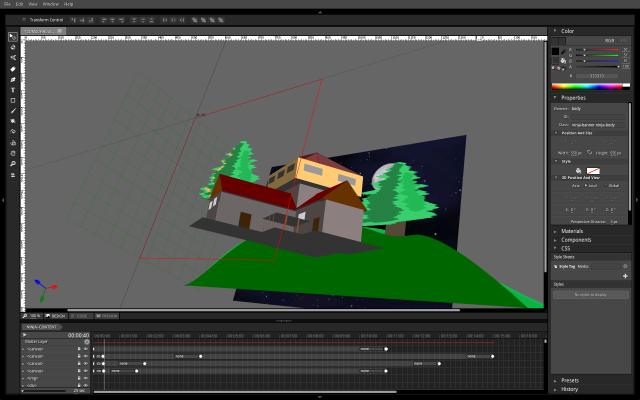
The Ninja HTML5 editor in action
Modern HTML rendering engines and emerging standards make it possible to create a new class of rich experiences that could previously be achieved only with native development toolkits—but developers need better Web development frameworks and authoring tools in order to take advantage of the possibilities.
Three new open-source software projects developed at Motorola Mobility hope to address the problem. We—Tim Statler, Zachary Cohen, and Kris Kowal—have had the pleasure of working on a new content creation tool called Ninja, a JavaScript development framework called Montage, and a testing automation tool called Screening. In this article, we will describe all three pieces of software, and we've included code examples to illustrate some of the functionality. But first—a high-level overview.
The Ninja authoring tool is a Google Chrome app for designing keyframe-based animation with HTML5, including 3D scenes and vector graphics. These scenes can incorporate components built on the Montage framework (see below), and the editor itself is built using Montage. Ninja includes a familiar set of drawing and layout tools, such as the Pen and Brush tools for creating graphics, shape primitives, and the Tag tool for creating page structure (<div> or <img> tags, for instance). Graphics you create in Ninja can be rendered in the browser with either the Canvas 2D API or WebGL. Designers can add Montage components to their projects and use the visual data binding feature to easily synchronize property values between components. Finally, Ninja produces high-quality code output that can be easily be maintained, even outside of the Ninja tool.
Subscribe to:
Posts (Atom)