Showing posts with label indystate. Show all posts

Thursday, March 14, 2013

Find: Chrome hits 17-month low, Windows 8 still only creeping upward

Chrome hits 17-month low, Windows 8 still only creeping upward


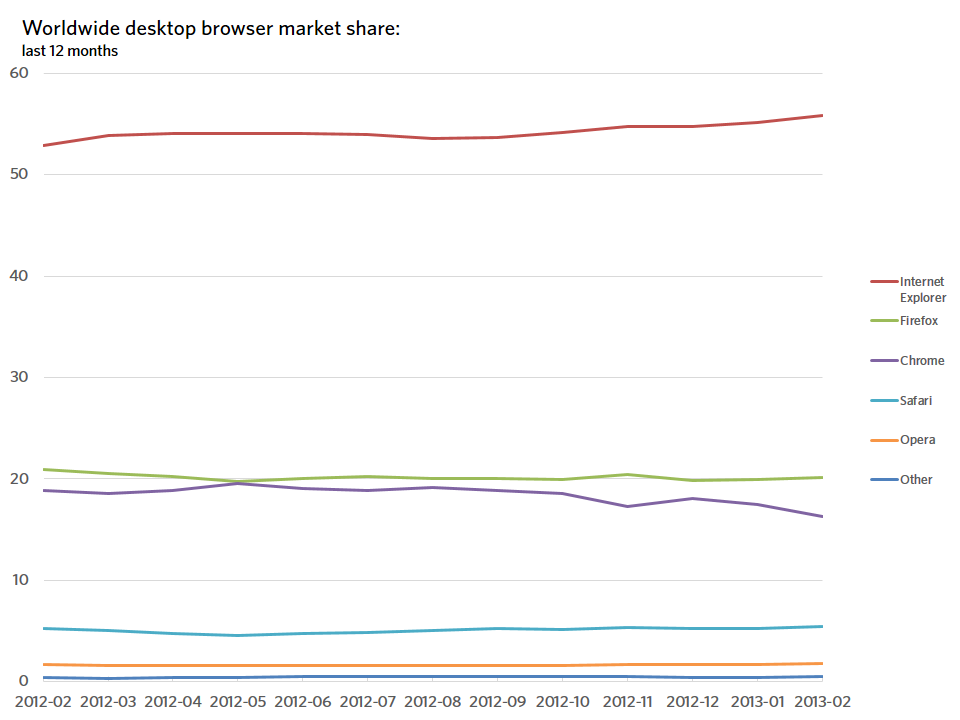
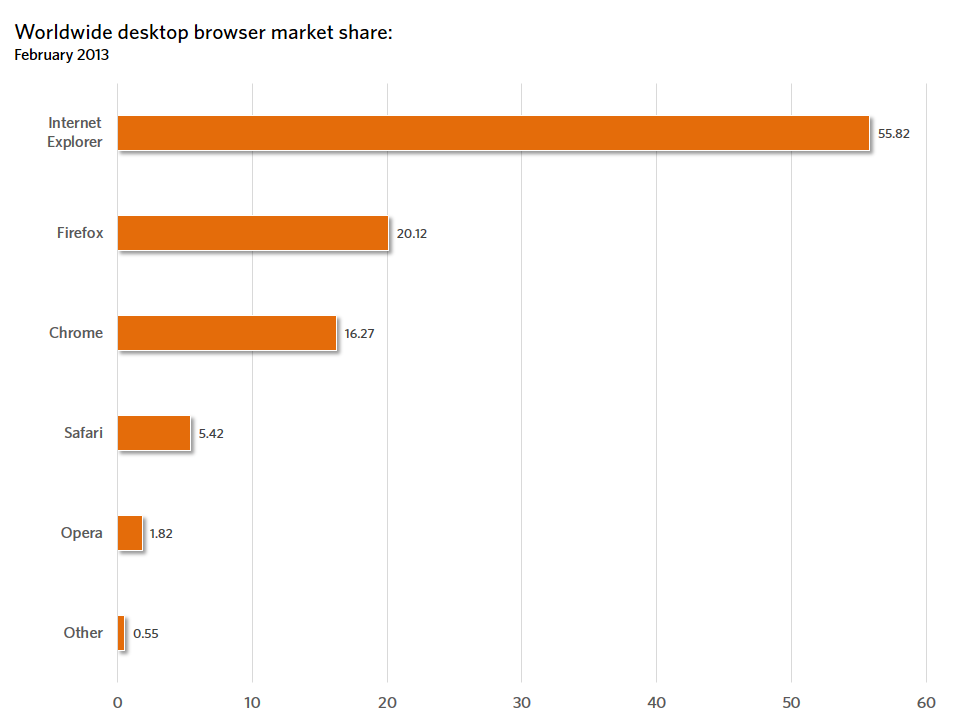
Microsoft's browser did as well as Google's browser did badly in February. Internet Explorer's share is the highest it's been in a year and a half. Chrome's is the lowest it's been in almost as long.


Internet Explorer was up 0.68 points to 55.82 percent. Firefox was back up above 20 percent, growing 0.18 points to 20.12 percent. Chrome was down sharply, losing a surprising 1.21 (giga) points, for a share of 16.27 percent. Safari and Opera were both up slightly, with gains of 0.18 and 0.07 points for a total of 5.42 and 1.82 percent, respectively

Saturday, February 2, 2013

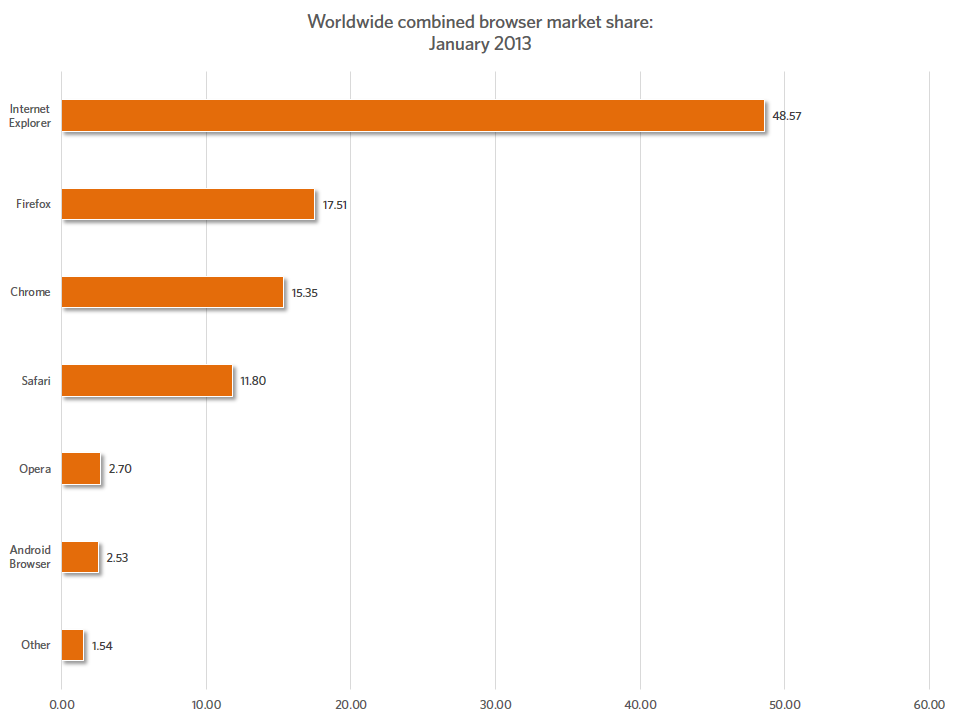
Find: indystate, browsing - safari dominates mobile browsing at 60 %

Internet Explorer still growing as Windows 7 starts its decline

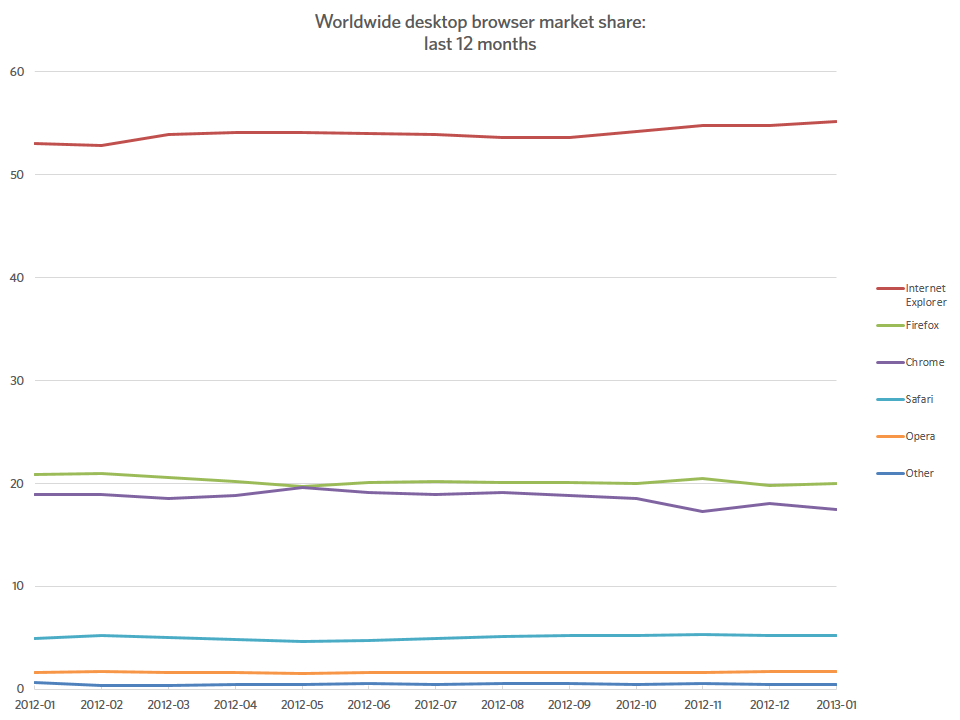
In the first month of 2013, Internet Explorer's desktop market share is continuing to slowly climb upwards, with Firefox consolidating its number two spot. There are signs that Windows 7 may have peaked as Windows 8 is slowly picking up users.


January was a good month for Microsoft's browser, up 0.37 points to 55.14 percent. Firefox also grew, up 0.12 points to 19.94 percent. Chrome fell, down 0.56 points to 17.48 percent. Safari was unchanged at 5.24 percent, and Opera up a hair, gaining 0.04 points to reach 1.75 percent.

The improvement of Internet Explorer's position masks a story that's decidedly mixed for Microsoft. Windows 7 fell for the first time in January, dropping 0.63 points from a high of 45.11 percent to 44.48 percent. Windows 8's slow growth is continuing, up 0.54 points from 1.72 percent to 2.26 percent. There's also a small number of tablet users, with 0.08 percent on Windows 8 Touch and a minuscule 0.02 percent on Windows RT Touch.

Monday, November 26, 2012

Find: How mobile is taking over our computing load, hour by hour

How mobile is taking over our computing load, hour by hour

Although mobile has been coming on strong as a primary means of computing, it still lags overall desktop internet usage. But for some publishers who started on the web, there are already moments during the week when mobile drives the majority of traffic or sales.
Guardian

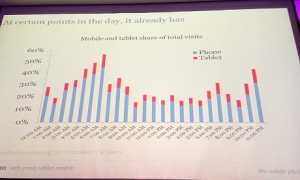
The Guardian’s traffic by hour

The Guardian’s Anthony Sullivan, group product manager for Guardian Core products at Guardian News & Media, said Monday that mobile — both smartphones and tablets — now contributes about 35 percent of traffic overall. That’s up from 10 percent at the start of 2011, when it was primarily smartphone traffic. (See disclosure below)

But at 6 a.m. to 7 a.m. in the morning local time, the Guardian gets more traffic from mobile devices. It also sees more mobile visitors than desktop visitors on Saturdays at 3 p.m. when the Premier League is under way.

Meanwhile, online design store Fab.com said late last month that on Saturdays between 12:00 a.m. and 6 a.m. local time, it sees 53 percent of its sales from mobile devices. On recent weekends, sales from mobile devices are now up to 40 percent, with weekend mornings before noon leading the way. Saturday evenings are also very popular with mobile users, with 44 percent of users buying on mobile devices between 6 p.m. and midnight.

The numbers are still early and these two properties are pretty popular with mobile users. Sullivan said in a Guardian story that the tipping point in favor of mobile might still be two years away. Fab’s CEO and co-founder Jason Goldberg, however, said based on the fast growth of mobile sales, he believes that Fab will see more parts of the day in which traffic from mobile devices goes over 50 percent in the coming months. And he said mobile will contribute more sales than desktop on certain days “soon.” Currently, 33 percent of Fab’s sales come from mobile devices.

The numbers underscore why mobile is so powerful. And it highlights the continuous nature of computing these days. The reality is today we are constantly on some type of computer throughout the day, moving back and forth between devices for different tasks and different settings. Mobile devices fill in the times when reaching for a laptop or desktop is more difficult, including early mornings, during lunch, as we settle in for the night and during the weekends....

Monday, October 1, 2012

Find: Indystate - Peak Chrome? Google's browser falls as Firefox, Internet Explorer stay flat

Peak Chrome? Google's browser falls as Firefox, Internet Explorer stay flat

Once again, Firefox has maintained its grip on second place, behind Internet Explorer. And as Chrome falls away, there's now a gap of more than one percentage point between the browsers.

During 2011, Chrome's rise was unstoppable, and it looked as if taking second place was an inevitability. In 2012, Google's browser has come close, but never quite managed to close the gap even with Google's extensive advertising and promotion.


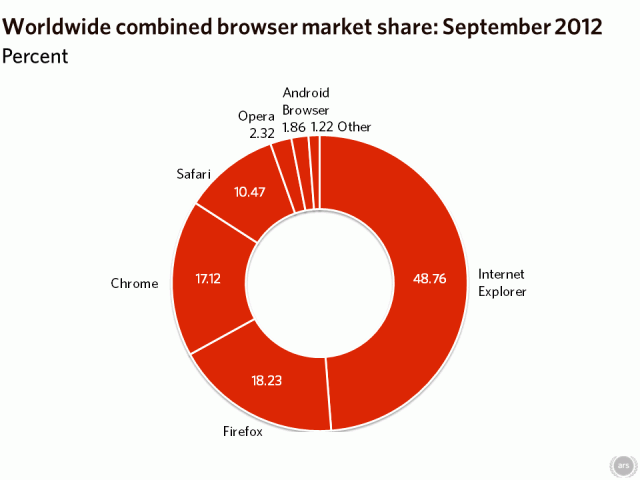
Internet Explorer and Firefox are essentially unchanged, each gaining 0.03 points to 53.63 and 20.08 percent respectively. Chrome has dropped 0.27 points to 18.86 percent, Safari picked up 0.16 points for a total of 5.26 points, and Opera edged up slightly, by 0.04 points to 1.62 percent.

Sunday, September 9, 2012

Find: Indystate by netapp - Chrome growth picks up

Chrome growth picks up; Windows 7 becomes the world's most used OS


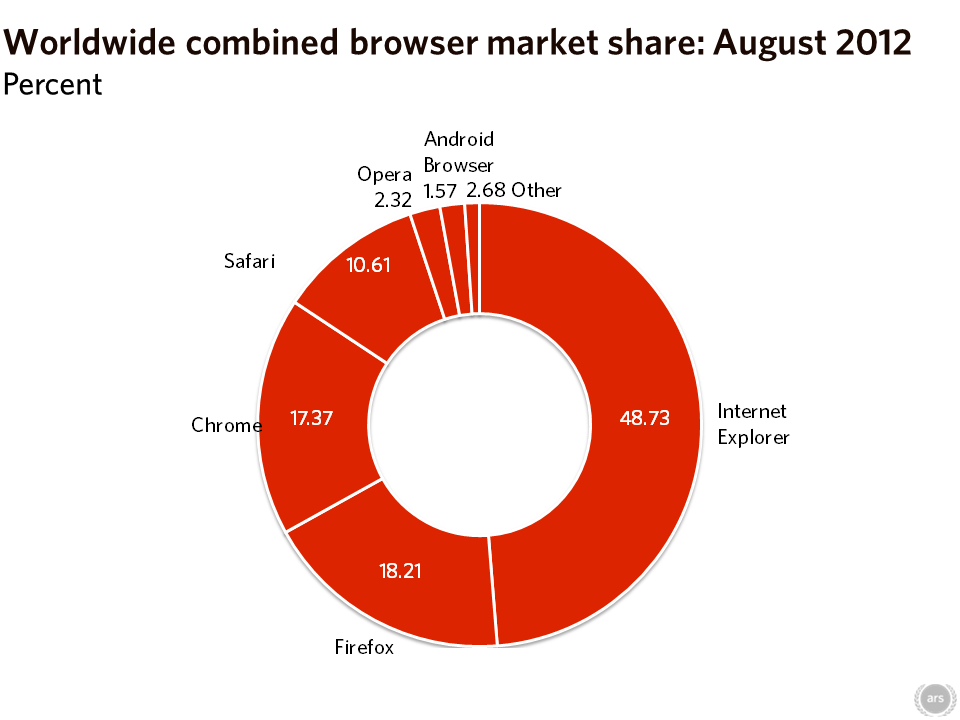
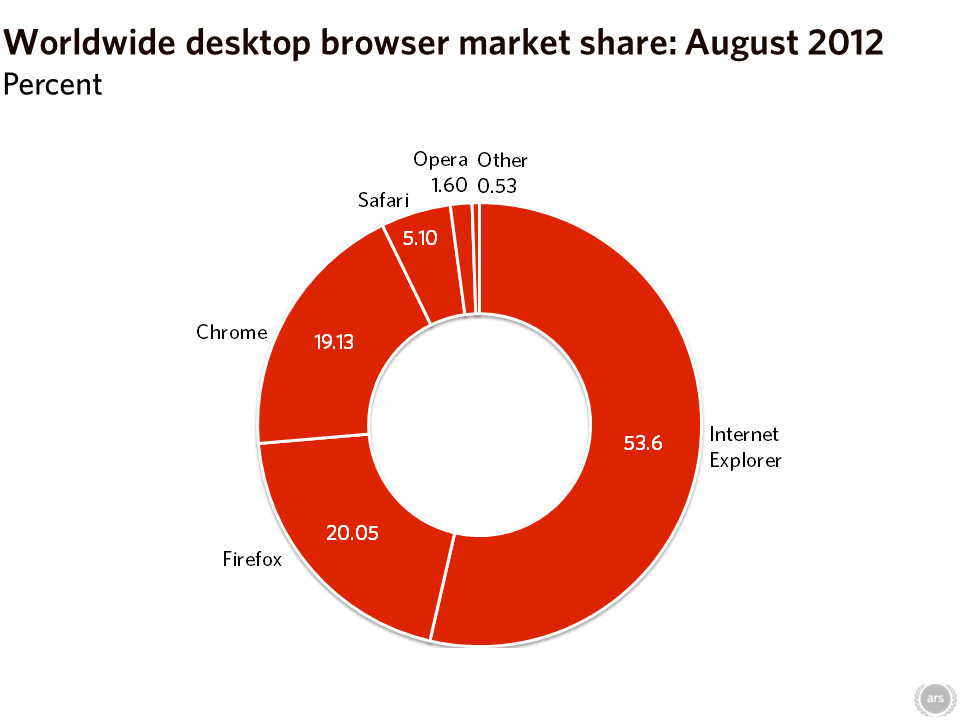
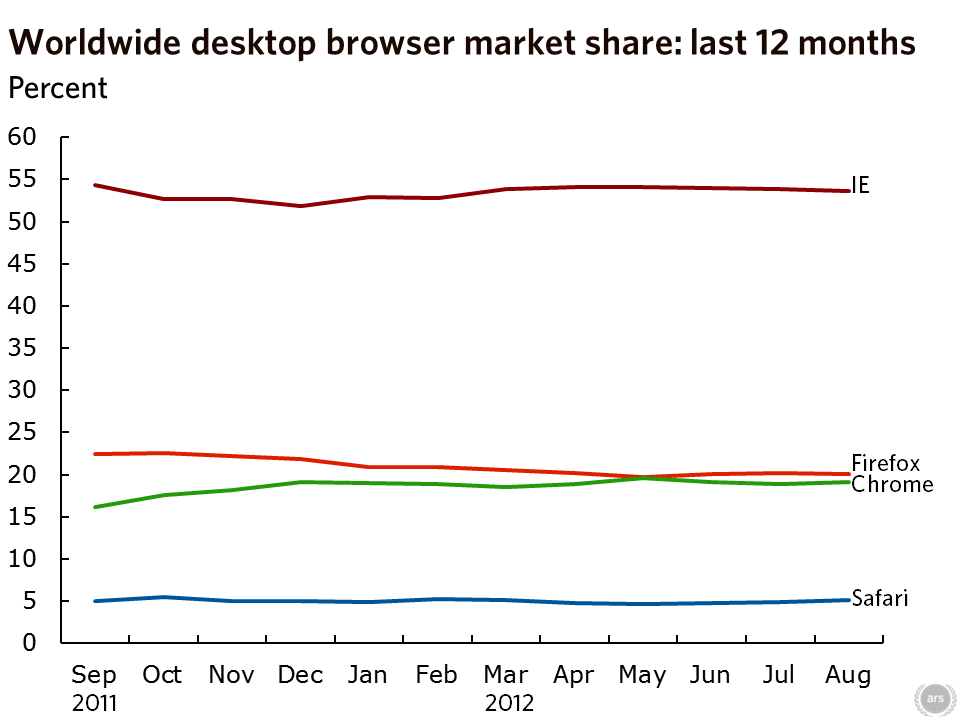
The last few months have seen Chrome poised to overtake Firefox as the second most widely used browser, and Windows 7 on the cusp of overtaking Windows XP to become the most popular operating system. For a long time it looked as if Chrome would win its race first, but in June and July its market share declined, allowing Firefox to strengthen its lead.

In August, Chrome resumed its gains, but didn't grow enough to leapfrog Firefox. Windows 7, however, has at long last overtaken the 11-year-old Windows XP—in the same month that its successor, Windows 8, made its way to the first end-user systems.


Internet Explorer is down 0.3 points to 53.6 percent. Firefox dropped 0.15 points to 20.05 percent. Chrome picked up 0.23 points to 19.13 percent. Safari gained 0.2 points to 5.1 percent, while Opera was essentially unchanged, down 0.01 points to 1.58 percent.