Showing posts with label apps. Show all posts

Sunday, December 2, 2012

Find: Good idea - Music Hack Day project maps out lyrics to Johnny Cash's 'I've Been Everywhere' in realtime
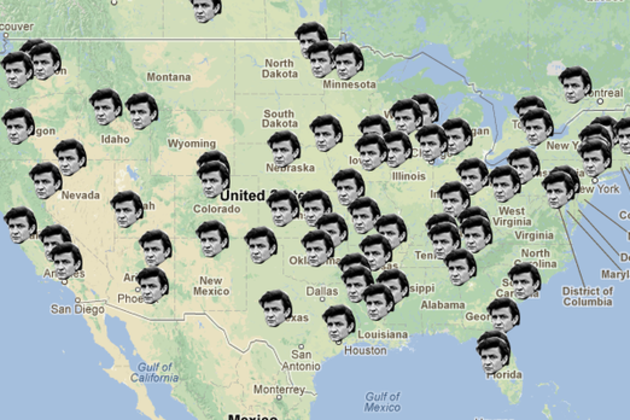
Music Hack Day project maps out lyrics to Johnny Cash's 'I've Been Everywhere' in realtime

Cash I've Been Everywhere

In 1996, the legendary Johnny Cash recorded "I've Been Everywhere," putting his signature on an old-time country classic. The song, which rattles off dozens of locations throughout North America, was an appropriate fit a musician that toured rigorously throughout his storied career. Now through the magic of Google Maps, you can listen to the song while each one of those destinations is labeled with a Johnny Cash pin — all in realtime before your own eyes. Developer Iain Mullan whipped the project together for Music Hack Day London 2012 using MusixMatch (for lyrics), Toma HK and his own programming know-how. In all, mapping out "I've Been Everywhere"'s itinerary results in 112515 miles of travel. Cash undoubtedly crossed through many of...

Wednesday, November 21, 2012

Find: How Team Obama's tech efficiency left Romney IT in dust

How Team Obama's tech efficiency left Romney IT in dust


Aurich Lawson

Despite running a campaign with about twice the money and twice the staff of Governor Mitt Romney's presidential bid, President Barack Obama's campaign under-spent Romney's on IT products and services by $14.5 million, putting the money instead into building an internal tech team. Based on an Ars analysis of Federal Election Commission filings, the Obama campaign, all-inclusive, spent $9.3 million on technology services and consulting and under $2 million on internal technology-related payroll.

The bottom line is that the Obama campaign's emphasis on people over capital and use of open-source tools to develop and operate its sophisticated cloud-based infrastructure ended up actually saving the campaign money. As Scott VanDenPlas, lead DevOps for Obama for America put it in an e-mail interview with Ars, "A lesson which we took to heart from 2008 [was that] operational efficiency is an enormous strategic advantage."

The Romney campaign spent $23.6 million on outside technology services—most of it on outside "digital media" consulting and data management. It outsourced most of its basic IT operations, while the Obama campaign did the opposite—buying hardware and software licenses, and hiring its own IT department. Just how much emphasis the Obama campaign put on IT is demonstrated by the fact that the campaign's most highly paid staff member was its CIO, Michael Slaby, with an annualized salary of about $130,000...

Sunday, November 4, 2012

Find: 'Pinch' connects multiple smartphones and tablets together to make a display

An idea we've played with in class. 

'Pinch' connects multiple smartphones and tablets together to make a display

Photo

Not content with synchronizing your phones to make one giant speaker? Researchers at the Tokyo University of Technology have developed "Pinch," an interface that lets you connect multiple devices together to form a giant disjointed display. Although the technology behind the interface remains a mystery — described only as a Wi-Fi based system — a video posted by DigInfo TV shows Pinch in action. To connect two devices, a user simply needs to pinch two adjacent screens together. The screens can be linked together in whatever alignment you choose, as the position and screen size of each display is communicated on a successful pinch. It's not the first time developers have managed to link together multiple smartphone displays, but this...

Saturday, October 6, 2012

Find: The New York Times launches HTML5 web app for iPad, dodges Apple's in-app subscription fees

Apple is incentivizing the development of html5 as an alternative to the app store's 30% cut. 

The New York Times launches HTML5 web app for iPad, dodges Apple's in-app subscription fees

The New York Times iPad web app

Today, The New York Times announced a new HTML5 web app for the iPad, likely introduced in an attempt to avoid Apple's 30 percent cut of in-app purchases. The Times did state that "subscribers have told us they are interested in trying new ways of reading The Times across a variety of platforms" which may indicate intent to extend the new web app to Android and Windows 8. We've reached out to The New York Times for more information on future development plans. The web app for iPad is currently available to digital subscribers, and can be accessed using Safari.

Update: New York Times corporate communications manager Linda Zebian responded with the following statement:

We developed the app as part of our NYT Everywhere Strategy—which...

Thursday, September 27, 2012

Find: 500 Chrome Experiments and counting...

500 Chrome Experiments and counting...

The web is capable of amazing things and is becoming more capable all the time. To show some of the potential of a better web, we launched ChromeExperiments.com in March 2009 with 19 inspiring examples by the creative coding community of what’s possible when combining the latest web technologies with a little code and imagination. Some of those original experiments, like Google Gravity and Ball Pool, are still popular today. But we’re pleased to say that they’ve since been joined by hundreds of other contributions from around that world that have pushed the web even further.

Today marks our 500th experiment, and in celebration, we created Experiment 500 as a thank you note to everyone who submitted their work to the site. It’s an array of interactive particles, each one of them corresponding to a different submission. You can sort them by date or by category.

Celebrating 500 Chrome Experiments

As you browse the experiments, you’ll notice that Chrome Experiments has evolved along with the web in the last 3.5 years. After Google Chrome added support for WebGL, for example, we started seeing beautiful 3D graphics experiments like Evan Wallace’s WebGL Water Simulation and HelloEnjoy’s Lights. When Web Audio came out, we received experiments that let users compose music together, such as Brandon Lockaby’s Multiplayer Piano and Dinahmoe’s Plink. This summer, with the release of Chrome for Android and iOS, we also announced a new gallery of mobile experiments, with submissions including AlteredQualia’s Multitouch Toy and Dominic Szablewski’s X-Type. Lately, we’ve seen real-...

Competition: Mozilla and National Science Foundation seek developers to build “apps from the future”

Can't see the deadline here. 

Mozilla and National Science Foundation seek developers to build “apps from the future”

Today, Mozilla and the National Science Foundation announced eight winning ideas that offer a glimpse of what the internet of the future might look like. Next up: invite developers everywhere to make these and other big ideas a reality.

Eight teams were awarded prizes today for their submissions to the Brainstorming Round of “Mozilla Ignite,” an open innovation challenge that invites developers and the general public to imagine and build applications that make use of ultra-fast, deeply programmable networks up to 250 times faster than today’s internet.

The proposed apps are aimed specifically at areas that create public benefit. Categories range from education, healthcare, public safety and clean energy to transportation, workforce development and advanced manufacturing.

Development Round now open

Now that the initial “Brainstorming Round” is complete, the challenge moves into the “Development Round.” Developers can enter the challenge now to help build one of the winning ideas announced today, or submit their own completely new proposal.

$485,000 is available in funding to support winning proposals, and all are welcome to submit at mozillaignite.org. Winners will receive funding, mentorship from world-leading judges, and access to the National Science Foundation’s Global Environment for Network Innovation (GENI), one of the most advanced test-bed networks in the world.

Brainstorming apps from the future

Here are the eight winning ideas announced today from the Mozilla Ignite Challenge’s “Brainstorming Round:”

  • Real-Time Emergency Response Observation and Supervision

    Jeremy Cooperstock, Shared Reality Lab, McGill University

    This app saves lives. The goal: arm firefighters, rescue workers and first-responders with powerful new real-time data and communications. Combining live, high-quality video from multiple feeds with real-time sensor data — like heat and smoke levels — could dramatically improve decision-making and coordination.


  • Real-time ...

Thursday, September 6, 2012

Find: Grooveshark's new HTML 5 mobile site

Grooveshark's new HTML 5 mobile site seeks to eliminate the need for a dedicated app

Grooveshark HTML 5 app

Last week, music streaming site Grooveshark found itself in a new bit of controversy — its Android app was reinstated to the Google Play Store for just a few days before being unceremoniously yanked from the store yet again. While Grooveshark said that it was still hoping to have its app back in the Play Store soon, the company just announced a major HTML 5 redesign to its mobile site that eliminates the need for a dedicated app — so users of Android, iOS, or any other modern mobile OS can take advantage of the site. Unlike the beta version that Grooveshark released way back in January, the new release allows users to sign in to their existing accounts and access their saved playlists and favorited tracks.

Unsurprisingly, the service...

Monday, August 20, 2012

Competition: Mozilla Ignite

Via our lab's collaborator Carol Strohecker:

Easy brainstorm deadline on Thursday, succeed you win money and more development rounds follow.


Benjamin Watson
Director, Design Graphics Lab | Associate Professor, Computer Science, NC State Univ.
919-513-0325 | designgraphics.ncsu.edu | @dgllab

---------- Forwarded message ----------
Subject: Mozilla Ignite

Calling all developers, network engineers and community catalysts. Mozilla and the National Science Foundation (NSF) invite designers, developers and everyday people to brainstorm and build applications for the faster, smarter Internet of the future. The goal: create apps that take advantage of next-generation networks up to 250 times faster than today, in areas that benefit the public -- like education, healthcare, transportation, manufacturing, public safety and clean energy.

Wednesday, August 15, 2012

Find: The Tech Behind the New Twitter.com

The Tech Behind the New Twitter.com

The Twitter.com redesign presented an opportunity to make bold changes to the underlying technology of the website. With this in mind, we began implementing a new architecture almost entirely in JavaScript. We put special emphasis on ease of development, extensibility, and performance. Building the application on the client forced us to come up with unique solutions to bring our product to life, a few of which we’d like to highlight in this overview

Find: Twitter’s mobile web app delivers performance

Twitter’s mobile web app delivers performance

As the number of people using Twitter has grown, we've wanted to make sure that we deliver the best possible experience to users, regardless of platform or device. Since twitter.com is not optimized for smaller screens or touch interactions familiar to many smart phones, we decided to build a cross-platform web application that felt native in its responsiveness and speed for those who prefer accessing Twitter on their phone's or the tablet’s browser.

A better mobile user experience

When building mobile.twitter.com as a web client, we used many of the tools offered in HTML5, CSS3, and JavaScript to develop an application that has the same look, feel, and performance of a native mobile application. This post focuses on four primary areas of the mobile app architecture that enabled us to meet our performance and usability goals:


  • event listeners

  • scroll views

  • templates

  • storage

  • Twitter's mobile app architecture

Find: Startup Zenph relaunches as music online learning platform

Startup Zenph relaunches as music online learning platform

ZOENBacked by $900,000 in new financing with Intersouth Partners as the lead investor, a new company emerges from the assets of Zenph Sound Innovations.