Showing posts with label browsers. Show all posts

Saturday, April 6, 2013

Find: Google going its own way, forking WebKit rendering engine

This diversity will be good, and focusing in the code components chrome needs may also make it faster. 

---
 
 
Shared via feedly // published on Ars Technica // visit site
Google going its own way, forking WebKit rendering engine
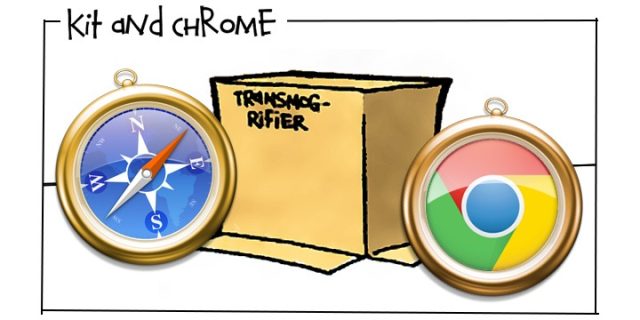
Aurich Lawson (with apologies to Bill Watterson)

Google announced today that it is forking the WebKit rendering engine on which its Chrome browser is based. The company is naming its new engine "Blink."

The WebKit project was started by Apple in 2001, itself a fork of a rendering engine called KHTML. The project includes a core rendering engine for handling HTML and CSS (WebCore), a JavaScript engine (JavaScriptCore), and a high-level API for embedding it into browsers (WebKit).

Though known widely as "WebKit," Google Chrome has used only WebCore since its launch in late 2008. Apple's Safari originally used the WebKit wrapper and now uses its successor, WebKit2. Many other browsers use varying amounts of the WebKit project, including the Symbian S60 browser, the BlackBerry browser, the webOS browser, and the Android browser.

Read 10 remaining paragraphs

Monday, November 26, 2012

Spotted: The Web Won't Be Safe or Secure until We Break It

The Web Won't Be Safe or Secure until We Break It

Unless you've taken very particular precautions, assume every Web site you visit knows exactly who you are.

Spotted: Browser Security Case Study: Appearances Can Be Deceiving

Browser Security Case Study: Appearances Can Be Deceiving

A discussion with Jeremiah Grossman, Ben Livshits, Rebecca Bace, and George Neville-Neil

Wednesday, October 10, 2012

Find: Firefox 16 adds more developer muscle, but Mac OS features lag

Firefox 16 adds more developer muscle, but Mac OS features lag


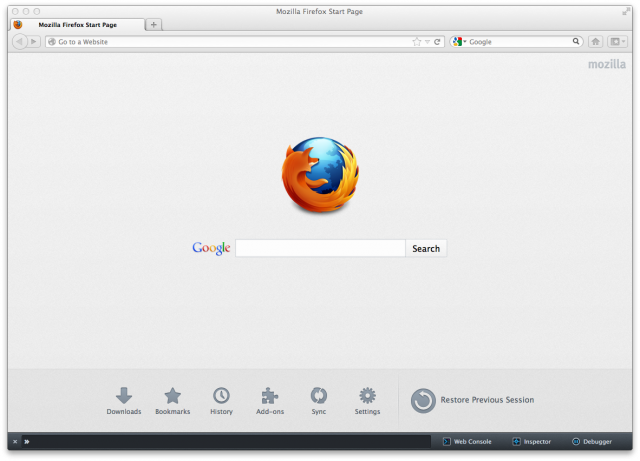
The default homepage of the latest edition of Firefox.

Mozilla has announced the public availability of Firefox 16, the latest version of its open-source web browser. While this version is light on new features that most users will notice—and missing some features many faithful users have been expecting—there are some major additions under the hood that will make Firefox 16 a better platform for developing apps for both the desktop browser and mobile web.

As we've reported, Firefox 15 included a whole host of user experience features, including some impressive support for web-based gaming. Firefox 16 is focused more on pushing forward the browser's support for advanced Cascading Style Sheets features and HTML 5 programming interfaces, as well as a pair of web APIs suited specifically to tablets and mobile devices. There's also a new feature of the browser that will appeal to both developers and power users: a command line that drives many of the browser's internal tools.

Underneath, there's a performance tweak to the garbage collection in Firefox's JavaScript engine. There's also a new security feature rolled out in Firefox 16, called "opt-in activation," that will allow Mozilla to reach out and configure users' browsers to prompt them to allow out-of-date or known vulnerable browser plug-ins from running.

Monday, October 1, 2012

Find: Indystate - Peak Chrome? Google's browser falls as Firefox, Internet Explorer stay flat

Peak Chrome? Google's browser falls as Firefox, Internet Explorer stay flat

Once again, Firefox has maintained its grip on second place, behind Internet Explorer. And as Chrome falls away, there's now a gap of more than one percentage point between the browsers.

During 2011, Chrome's rise was unstoppable, and it looked as if taking second place was an inevitability. In 2012, Google's browser has come close, but never quite managed to close the gap even with Google's extensive advertising and promotion.


Internet Explorer and Firefox are essentially unchanged, each gaining 0.03 points to 53.63 and 20.08 percent respectively. Chrome has dropped 0.27 points to 18.86 percent, Safari picked up 0.16 points for a total of 5.26 points, and Opera edged up slightly, by 0.04 points to 1.62 percent.

Sunday, September 9, 2012

Find: Indystate by netapp - Chrome growth picks up

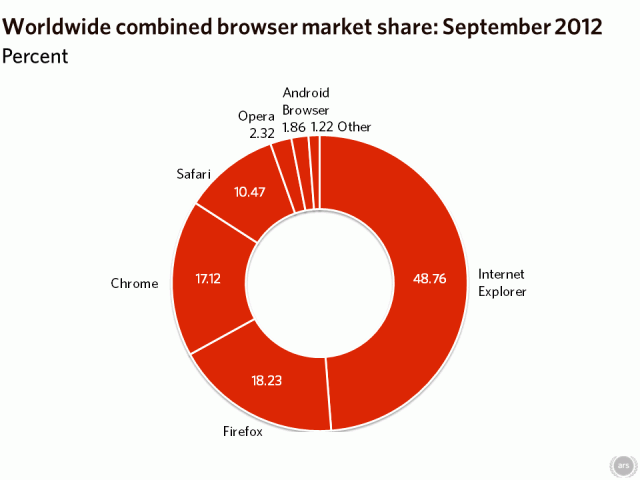
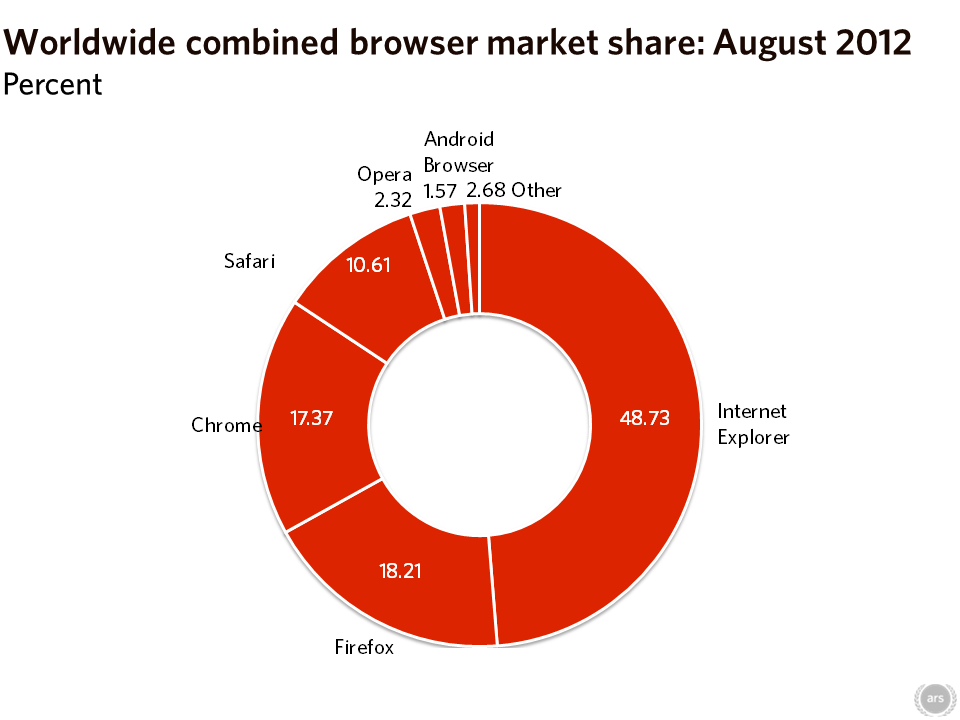
Chrome growth picks up; Windows 7 becomes the world's most used OS


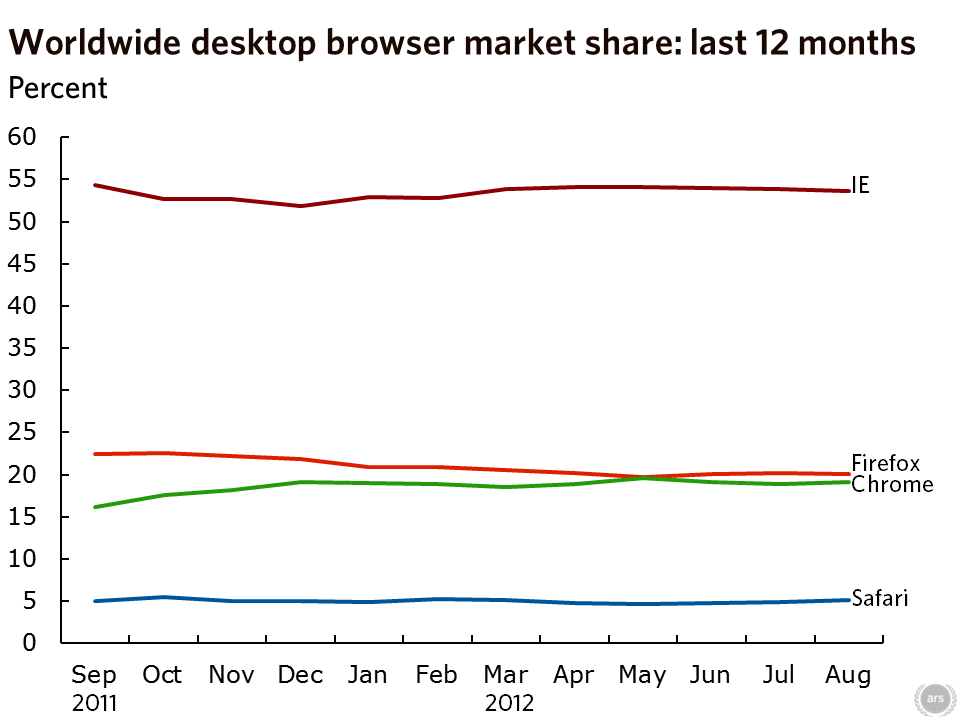
The last few months have seen Chrome poised to overtake Firefox as the second most widely used browser, and Windows 7 on the cusp of overtaking Windows XP to become the most popular operating system. For a long time it looked as if Chrome would win its race first, but in June and July its market share declined, allowing Firefox to strengthen its lead.

In August, Chrome resumed its gains, but didn't grow enough to leapfrog Firefox. Windows 7, however, has at long last overtaken the 11-year-old Windows XP—in the same month that its successor, Windows 8, made its way to the first end-user systems.


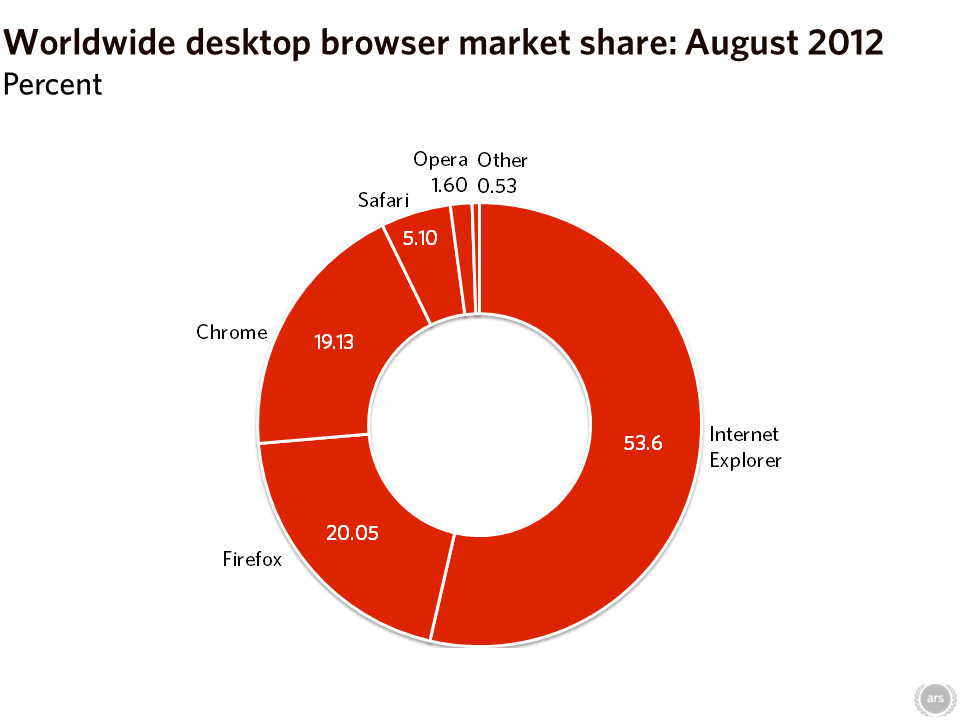
Internet Explorer is down 0.3 points to 53.6 percent. Firefox dropped 0.15 points to 20.05 percent. Chrome picked up 0.23 points to 19.13 percent. Safari gained 0.2 points to 5.1 percent, while Opera was essentially unchanged, down 0.01 points to 1.58 percent.

Friday, September 7, 2012

Find: Silk browser on Kindle Fire HD adds faster page loads, Trending Now list

Everything you surf to is recorded on amazon's silk browser, at least in sum. Opera does something similar. In exchange, faster browsing. 

Silk browser on Kindle Fire HD adds faster page loads, Trending Now list

amazon silk trending stock 1020

Amid all the excitement about its new Kindle Fire HD devices yesterday, one thing Amazon failed to mention is the new version of its Silk browser installed on the tablets. There are a number of meaningful improvements in the update, like better support for HTML5 web standards and an improved UI, but the biggest difference is speed — "at least a 30 percent reduction in page load latency," according to the company.

Silk is a so-called "split" browser, using Amazon’s servers to compress and simplify websites before they’re served to the user. While it speeds up the browsing experience, it also means Amazon can see anonymized data about the pages its users are accessing. As pointed out by TechCrunch, the updated version of Silk adds a...

Friday, August 31, 2012

Find: Firefox 15 - 3d gaming, js debugger, no extension mem leaks

Firefox 15 arrives, supports compressed textures for impressive 3D gaming


The BananaBread WebGL demo running in Firefox 15

Mozilla announced today the release of Firefox 15, a new version of the open source Web browser. The update brings a number of noteworthy enhancements, including new built-in development tools and enhanced support for cutting-edge Web standards that enable sophisticated gaming experiences. Under the hood, Firefox 15 introduces a new optimization that can radically reduce the browser’s memory footprint for users who rely on many add-ons.

As we have discussed in much of our recent browser coverage, modern standards-based Web technologies are increasingly capable of supporting the kind of interactive multimedia experiences that used to only be available through plugins or native applications. The major browser vendors, which are all working to further expand the range of capabilities offered by the Web, have recently taken an interest in enabling game development.

Mozilla has been working on a number of relevant features, including an API for displaying content in fullscreen mode, support for mouse-locking, and sophisticated real-time audio mixing functionality. Earlier this year, Mozilla launched its own real-time multiplayer adventure game called BrowserQuest with the aim of showcasing HTML5 gameplay. The open Web is clearly a serious contender for casual gaming.