Leads on using web Apis
Tim O'Reilly (@timoreilly)Short @Codecademy courses on how to use APIs to many common services. bit.ly/XkMdl9 Nice work! |
|
|
Tim O'Reilly (@timoreilly)Short @Codecademy courses on how to use APIs to many common services. bit.ly/XkMdl9 Nice work! |
|
|
The Twitter.com redesign presented an opportunity to make bold changes to the underlying technology of the website. With this in mind, we began implementing a new architecture almost entirely in JavaScript. We put special emphasis on ease of development, extensibility, and performance. Building the application on the client forced us to come up with unique solutions to bring our product to life, a few of which we’d like to highlight in this overview
 By Sam McCall, Software Engineer
Ever since we launched Dart, the structured web programming language, we've heard developers asking for a way to use Dart to connect to Google's most popular APIs and services. Thanks to Google's 20% time policy, I’m working on an open source library that helps Dart developers connect to Google APIs such as Google+, YouTube, URL Shortener, and many more.
My favorite sample showing you how to build web apps with Dart and Google APIs is roulette. This little app will shorten your URL, or if you're lucky, rickroll you.
This library is currently alpha and under active development. Please report all bugs in the issue tracker and ask questions in the discussion forum. Thanks for the feedback, and have fun!
Sam McCall is an engineer in Google’s Corporate Engineering Team in Munich, and is a part-time Dart tinkerer.
Posted by Scott Knaster, Editor

Amidst all the excitement of I/O followed by the July 4th holiday in the U.S., many developers missed the announcement of the new Fusion Tables API. The new API includes all of the functionality of the existing SQL API, plus the ability to read and modify table and column metadata as well as the definitions of styles and templates for data visualization. This API is also integrated with the Google APIs console which lets developers manage all their Google APIs in one place and take advantage of built-in reporting and authentication features.
With this launch, we are also announcing a six month deprecation period for the existing SQL API. Since the new API includes all of the functionality of the existing SQL API, developers can easily migrate their applications using our migration guide.For a detailed description of the features in the new API, please refer to the API documentation.
Posted by Ashleigh Rentz, Editor Emerita

Cross-posted with the Google Geo Developers Blog
How would you make your community or local government run better? In our first Google Places API Developer Challenge, we’re inviting developers around the world to make something that improves their communities or governments by using the Google Places API and its database of places and tools. The developers of the winning applications will receive a VIP experience at Google I/O 2013.
You might create an app or site that solves health problems, understands crime patterns, or improves commerce. You can use any platform as long as you build with the Google Places API and it benefits your community or government. We’re looking for your best and most innovative ideas.
To help you develop your ideas and build better apps, we’ve been working with local government officials in Austin, Boston, Chicago, London, Louisville, New York City, Philadelphia, Portland, San Francisco, and Seattle along with the White House to surface a wide variety of data sets for your apps. You can find these data sets and more on the Google Places API Challenge site at http://developers.google.com/challenge and hear more about what cities have to say about the challenge here. You can also follow updates and hangouts about the challenge on +Google Maps API.
The submission window opens on August 15th and closes on October 31st, 2012.
We look forward to seeing what can happen when your imagination and the Google Places API come together!
Going mobile with mgwt and gwt-phonegap
mgwt is a library for developing mobile apps and mobile websites with GWT using a single codebase. mgwt provides native-looking widgets and effects for most of the popular mobile platforms. It also comes with a ton of other useful features for building mobile apps. We’ve detailed some of them later on in the post.
gwt-phonegap enables GWT apps to use Phonegap. With Phonegap, HTML5 applications can access the same device features that native apps can use via Javascript APIs, such as the camera, file system or contacts.
Chrome now includes the getUserMedia API, which lets you grant web apps access to your camera and microphone without a plug-in. The getUserMedia API is the first step in WebRTC, a new real-time communications standard which aims to allow high-quality video and audio communication on the web.
The getUserMedia API also allows web apps to create awesome new experiences like Webcam Toy and Magic Xylophone. In Chrome Web Lab, if you're on the latest version of Chrome, the Sketchbots experiment uses getUserMedia to let you take a picture of your face, which is then converted to a line drawing and sent to a robot in the Science Museum in London. The robot then draws out your portrait in a patch of sand, which you can watch live on YouTube and visitors can watch in person at the museum. It’s just about as crazy as it sounds, and twice as cool.

Once you've taken your picture, it's transformed into a line drawing a robot can understand using HTML5 canvas.

Your portrait is then drawn by one of the eight Sketchbots in London. You can choose to be sent a video of the whole process.
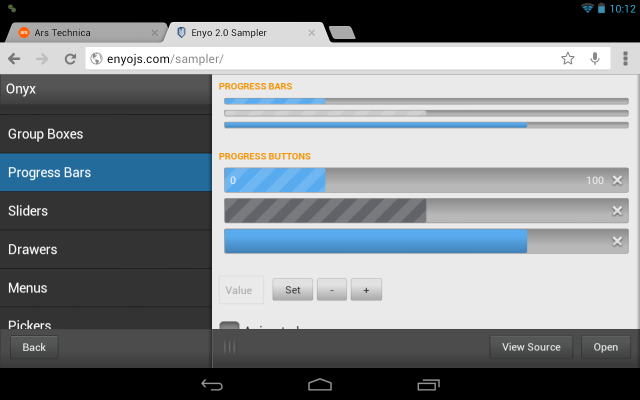
Enyo was originally the official development framework of webOS, the platform that HP obtained in its 2010 acquisition of Palm and later destroyed during Leo Apotheker’s rein of terror imbecility. Meg Whitman, who replaced Apotheker as CEO, decided to salvage the remaining value of webOS by opening the source code and building a community around the software.
HP first published the Enyo source code in January under the permissive Apache software license. The code drop included the original Enyo code, which was only intended to run on webOS, as well as a preliminary implementation of a major new version called Enyo 2.
 |
| Jake |
 |
| Antonio |
Google Developer Team
Last March we introduced the Google APIs Explorer, an interactive tool that enables you to try out a Google API in minutes and explore its supported methods. When we launched it, the APIs Explorer supported over a half dozen APIs.
Starting today, the APIs Explorer has a brand new look to make it easier and more fun to navigate. We are also adding new features, including an indexed history of your API calls, a better editor for the body of a request, and a search box so you can search for APIs and methods easily.

Moreover, we have been busy adding support for more APIs to the Explorer. The Explorer now supports over two dozen Google APIs, and the list continues to grow! We have also added an indicator to show which methods require authenticated requests.
To get started, here are some sample requests you can try in the Explorer:

