Showing posts with label firefox. Show all posts

Thursday, March 14, 2013

Find: Chrome hits 17-month low, Windows 8 still only creeping upward

Chrome hits 17-month low, Windows 8 still only creeping upward


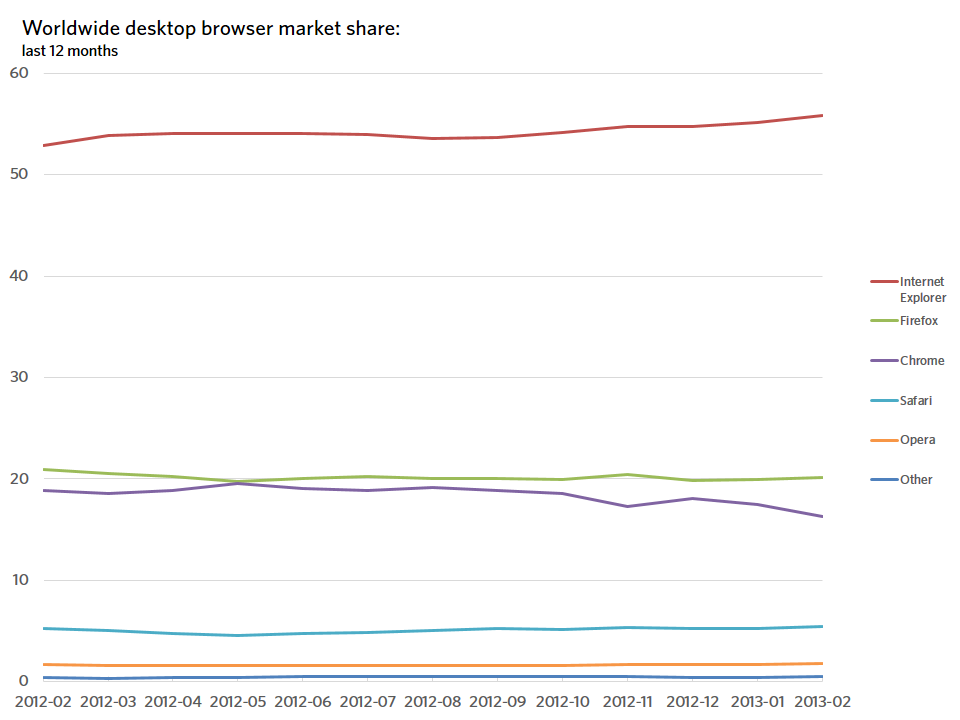
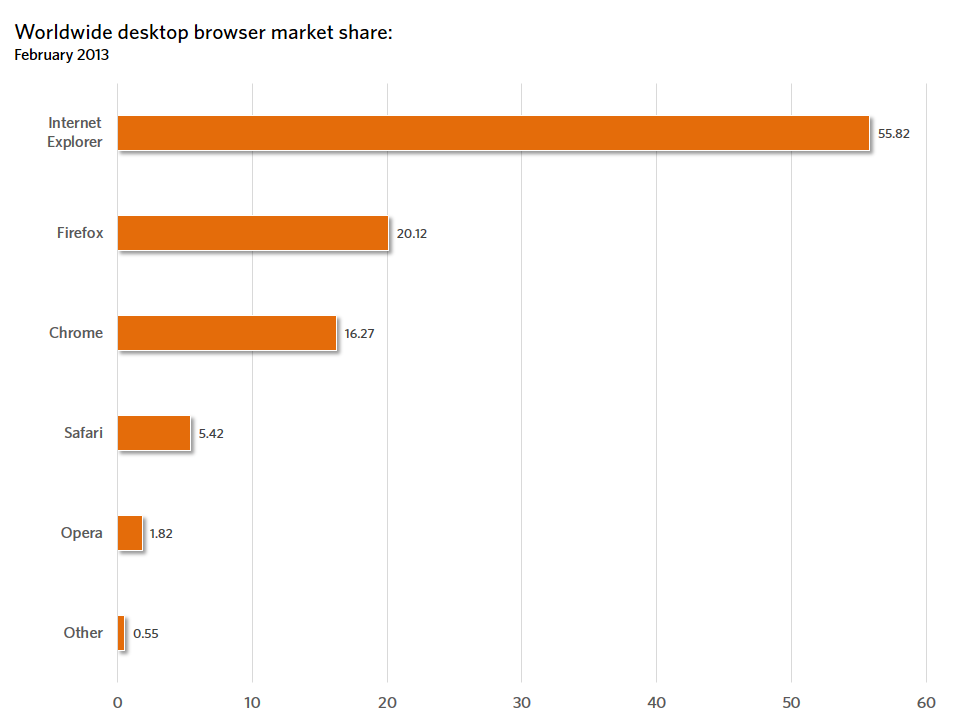
Microsoft's browser did as well as Google's browser did badly in February. Internet Explorer's share is the highest it's been in a year and a half. Chrome's is the lowest it's been in almost as long.


Internet Explorer was up 0.68 points to 55.82 percent. Firefox was back up above 20 percent, growing 0.18 points to 20.12 percent. Chrome was down sharply, losing a surprising 1.21 (giga) points, for a share of 16.27 percent. Safari and Opera were both up slightly, with gains of 0.18 and 0.07 points for a total of 5.42 and 1.82 percent, respectively

Friday, November 2, 2012

Find: Firefox gets strict about enforcement of HTTPS protection

Firefox gets strict about enforcement of HTTPS protection

Developers of Mozilla's Firefox browser are experimenting with a new security feature that connects to a specified set of websites only when presented with a cryptographic certificate validating the connection is secure.


A beta version of the open-source browser contains a list of sites known to deploy the HTTP Strict Transport Security mechanism that requires a browser to use the secure sockets layer or transport layer security protocols when communicating. HSTS is designed to provide an additional layer of security by mandating the channel is encrypted and the server has been authenticated using strong cryptography.


But there's a chicken-and-egg problem with HSTS. "Man-in-the-middle" attackers, who are positioned in between a browser and website, have the ability to prevent browsers from receiving the server code that enforces the additional protection. That makes it possible for HSTS to be circumvented by the very types of people the measure is designed to thwart.

Saturday, October 20, 2012

Find: Mozilla focusing on mobile

Update on Firefox Marketplace

Modern browsers based on open standards (like Firefox) enable developers to create amazing Web applications and websites. Mozilla is rapidly increasing the capabilities of the browser platform, which means developers can build more and more of their applications using Web technologies and we’ve been working hard to add more capabilities to the Web as a platform.

We first started working on building these capabilities into the Web and developing our own Firefox Marketplace last year. And, we have seen on the Web and particularly in mobile – Apps, those focused experiences are gaining massive adoption by consumers.

The future is mobile and we’ve made amazing progress with exposing Web APIs across platforms. We’re working to unlock the power of the Web on mobile, just as we did on desktop.

To this end, and based on what we have learned through our efforts to date, we’re now focusing our Marketplace offering. While we previously believed that desktop was the right initial first step to building out an HTML5 app ecosystem, we now believe that we need to pivot further and lead the way with mobile.

We’re not in any way changing our commitment to add features to Desktop as we still feel that Apps are as relevant on desktop as any other environment, but we do need to focus on mobile for the next few releases and as such you won’t see any changes in Desktop for a short period. As soon as mobile has caught up to desktop in features related to Apps we will refocus.

This means:

1) Mobile platforms will be the first target for our HTML5 apps, with desktop to follow providing the means for users to discover and manage their experience;

2) Initial platform targets are Firefox OS and Firefox for Android, with others to follow from our successes there.

We’re happy with the progress we’ve made and excited to share more soon about the next steps for the Web apps ecosystem and Firefox Marketplace. Stay tuned!

Wednesday, October 10, 2012

Find: Firefox 16 adds more developer muscle, but Mac OS features lag

Firefox 16 adds more developer muscle, but Mac OS features lag


The default homepage of the latest edition of Firefox.

Mozilla has announced the public availability of Firefox 16, the latest version of its open-source web browser. While this version is light on new features that most users will notice—and missing some features many faithful users have been expecting—there are some major additions under the hood that will make Firefox 16 a better platform for developing apps for both the desktop browser and mobile web.

As we've reported, Firefox 15 included a whole host of user experience features, including some impressive support for web-based gaming. Firefox 16 is focused more on pushing forward the browser's support for advanced Cascading Style Sheets features and HTML 5 programming interfaces, as well as a pair of web APIs suited specifically to tablets and mobile devices. There's also a new feature of the browser that will appeal to both developers and power users: a command line that drives many of the browser's internal tools.

Underneath, there's a performance tweak to the garbage collection in Firefox's JavaScript engine. There's also a new security feature rolled out in Firefox 16, called "opt-in activation," that will allow Mozilla to reach out and configure users' browsers to prompt them to allow out-of-date or known vulnerable browser plug-ins from running.

Monday, October 1, 2012

Find: Indystate - Peak Chrome? Google's browser falls as Firefox, Internet Explorer stay flat

Peak Chrome? Google's browser falls as Firefox, Internet Explorer stay flat

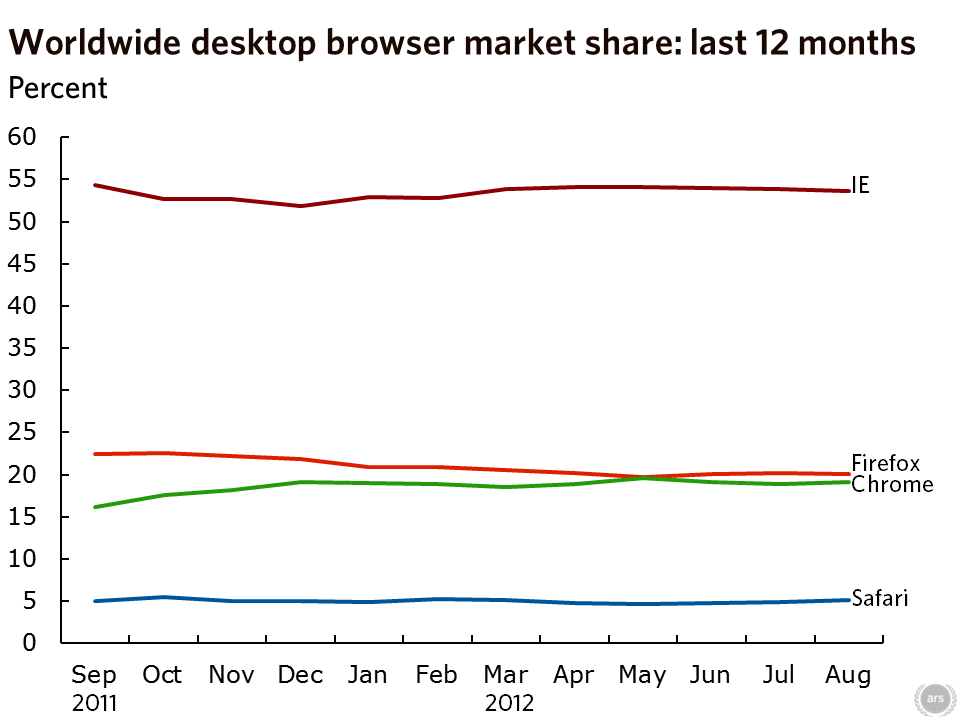
Once again, Firefox has maintained its grip on second place, behind Internet Explorer. And as Chrome falls away, there's now a gap of more than one percentage point between the browsers.

During 2011, Chrome's rise was unstoppable, and it looked as if taking second place was an inevitability. In 2012, Google's browser has come close, but never quite managed to close the gap even with Google's extensive advertising and promotion.


Internet Explorer and Firefox are essentially unchanged, each gaining 0.03 points to 53.63 and 20.08 percent respectively. Chrome has dropped 0.27 points to 18.86 percent, Safari picked up 0.16 points for a total of 5.26 points, and Opera edged up slightly, by 0.04 points to 1.62 percent.

Wednesday, September 12, 2012

Find: Mozilla beefing up JavaScript performance with new JIT compiler

Mozilla beefing up JavaScript performance with new JIT compiler

In an effort to keep Firefox competitive with commercial browsers and handle the ever-heavier burden that interactive webpages put on browsers’ scripting engines, Mozilla is working on a new JavaScript just-in-time (JIT) compiler architecture for Firefox’s SpiderMonkey script engine that will significantly boost the browser’s performance. Called IonMonkey, the JIT is now part of the nightly Firefox test builds, and is set for wide release as part of Firefox 18.

In a post on Mozilla’s JavaScript blog, Mozilla developer David Anderson said that the architecture of IonMonkey uses a three-step compilation process for JavaScript that mirrors how production compilers for languages such as C++ and Java work, performing analysis and optimization of the intermediate representation (IR) of the script code before turning it into the machine code run by SpiderMonkey. In the current JägerMonkey JIT, there is no optimization step. IonMonkey is targeted at long-running JavaScript applications; for shorter ones, Firefox will continue to use the current JägerMonkey JIT.

The initial performance results for IonMonkey are substantially better than previous versions of the JIT. On Google’s V8 benchmark, the test version of Firefox 18 scored a 7 percent improvement in performance over Firefox 17; with Mozilla’s own Kraken benchmark, IonMonkey resulted in about a 26 percent performance boost over Firefox 17. “We’re excited about this not just for performance and maintainability,” Anderson wrote. “but also for making future JavaScript compiler research much easier. It’s now possible to write an optimization algorithm, plug it into the pipeline, and see what it does.”

Sunday, September 9, 2012

Find: Indystate by netapp - Chrome growth picks up

Chrome growth picks up; Windows 7 becomes the world's most used OS


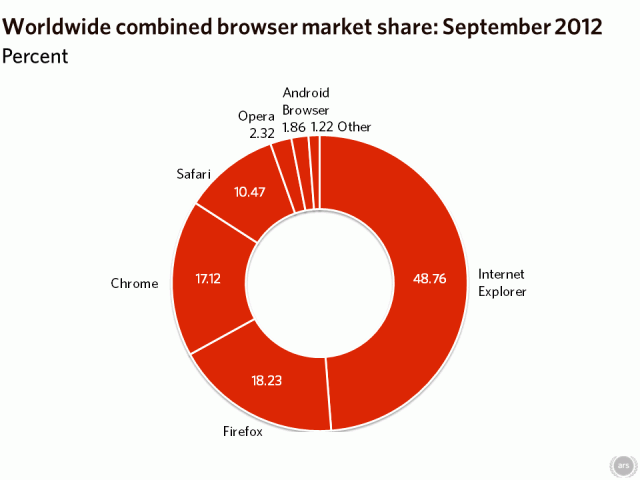
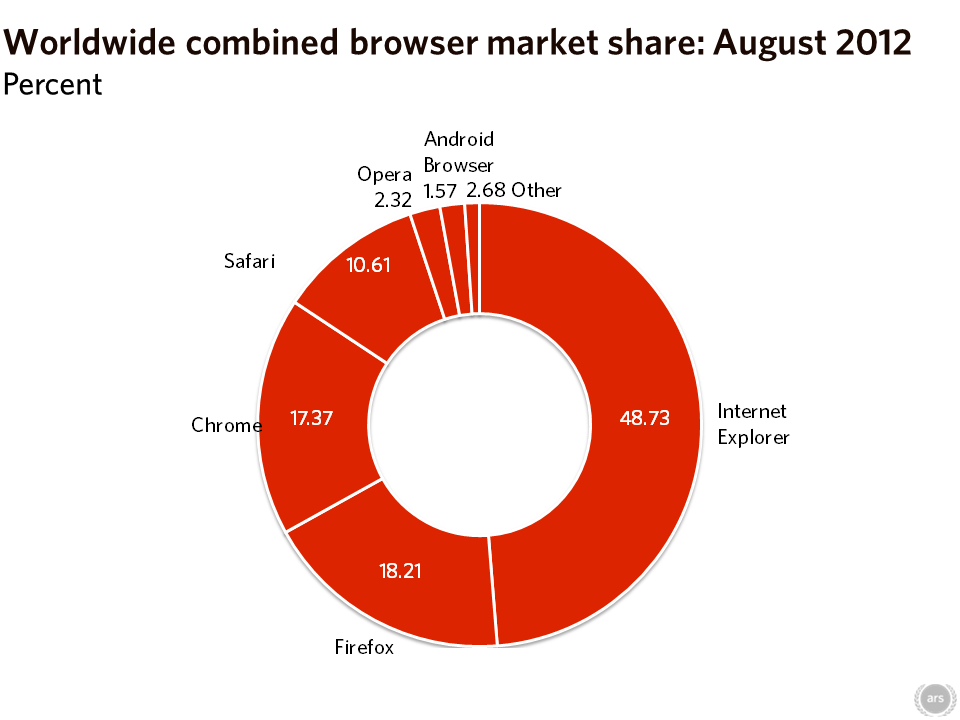
The last few months have seen Chrome poised to overtake Firefox as the second most widely used browser, and Windows 7 on the cusp of overtaking Windows XP to become the most popular operating system. For a long time it looked as if Chrome would win its race first, but in June and July its market share declined, allowing Firefox to strengthen its lead.

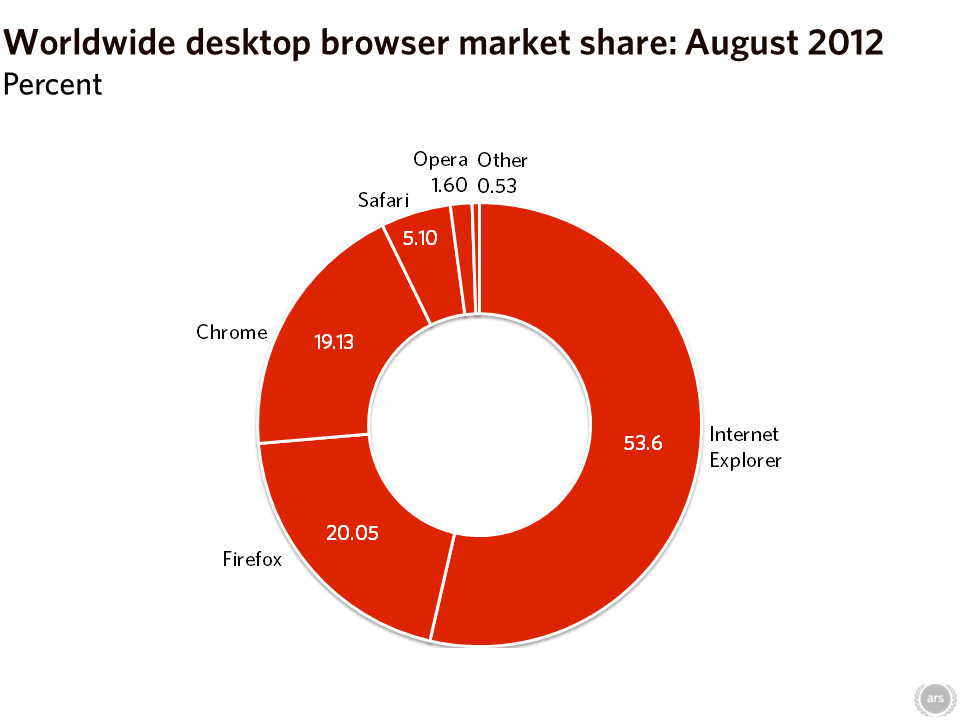
In August, Chrome resumed its gains, but didn't grow enough to leapfrog Firefox. Windows 7, however, has at long last overtaken the 11-year-old Windows XP—in the same month that its successor, Windows 8, made its way to the first end-user systems.


Internet Explorer is down 0.3 points to 53.6 percent. Firefox dropped 0.15 points to 20.05 percent. Chrome picked up 0.23 points to 19.13 percent. Safari gained 0.2 points to 5.1 percent, while Opera was essentially unchanged, down 0.01 points to 1.58 percent.

Friday, August 31, 2012

Find: Firefox 15 - 3d gaming, js debugger, no extension mem leaks

Firefox 15 arrives, supports compressed textures for impressive 3D gaming


The BananaBread WebGL demo running in Firefox 15

Mozilla announced today the release of Firefox 15, a new version of the open source Web browser. The update brings a number of noteworthy enhancements, including new built-in development tools and enhanced support for cutting-edge Web standards that enable sophisticated gaming experiences. Under the hood, Firefox 15 introduces a new optimization that can radically reduce the browser’s memory footprint for users who rely on many add-ons.

As we have discussed in much of our recent browser coverage, modern standards-based Web technologies are increasingly capable of supporting the kind of interactive multimedia experiences that used to only be available through plugins or native applications. The major browser vendors, which are all working to further expand the range of capabilities offered by the Web, have recently taken an interest in enabling game development.

Mozilla has been working on a number of relevant features, including an API for displaying content in fullscreen mode, support for mouse-locking, and sophisticated real-time audio mixing functionality. Earlier this year, Mozilla launched its own real-time multiplayer adventure game called BrowserQuest with the aim of showcasing HTML5 gameplay. The open Web is clearly a serious contender for casual gaming.

Find: a nice review of Firefox dev tools

Wednesday, August 15, 2012

Find: Improving Browser Security with CSP

Improving Browser Security with CSP

If you are using Firefox 4, you now have an extra layer of security when accessing mobile.twitter.com.

Over the past few weeks we've been testing a new security feature for our mobile site. It is called a Content Security Policy, or CSP. This policy is a standard developed by Mozilla that aims to thwart cross site scripting (XSS) attacks at their point of execution, the browser. The upcoming release of Firefox 4 implements CSP, and while the mobile site may not get a high volume of desktop browser traffic (the desktop users hitting that site typically have low bandwidth connections), it has given us an opportunity to test out a potentially powerful anti-XSS tool in a controlled setting.

CSP IN A NUTSHELL

In a typical XSS attack, the attacker injects arbitrary Javascript into a page, which is then executed by an end-user. When a website enables CSP, the browser ignores inline Javascript and only loads external assets from a set of whitelisted sites. Enabling CSP on our site was simply a matter of including the policy in the returned headers under the CSP defined key, 'X-Content-Security-Policy'.

The policy also contains a 'reporting URI' to which the browser sends JSON reports of any violations. This feature not only assists debugging of the CSP rules, it also has the potential to alert a site’s owner to emerging threats.