Showing posts with label google. Show all posts

Saturday, April 6, 2013

Find: Google going its own way, forking WebKit rendering engine

This diversity will be good, and focusing in the code components chrome needs may also make it faster. 

---
 
 
Shared via feedly // published on Ars Technica // visit site
Google going its own way, forking WebKit rendering engine
Aurich Lawson (with apologies to Bill Watterson)

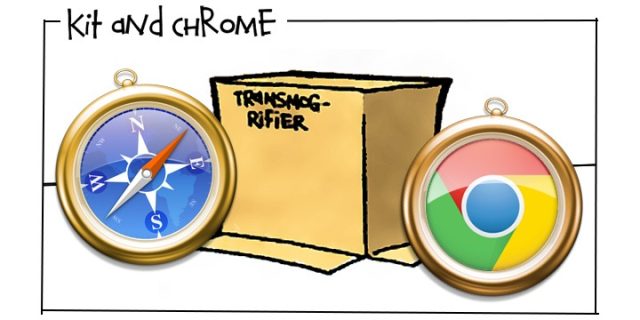
Google announced today that it is forking the WebKit rendering engine on which its Chrome browser is based. The company is naming its new engine "Blink."

The WebKit project was started by Apple in 2001, itself a fork of a rendering engine called KHTML. The project includes a core rendering engine for handling HTML and CSS (WebCore), a JavaScript engine (JavaScriptCore), and a high-level API for embedding it into browsers (WebKit).

Though known widely as "WebKit," Google Chrome has used only WebCore since its launch in late 2008. Apple's Safari originally used the WebKit wrapper and now uses its successor, WebKit2. Many other browsers use varying amounts of the WebKit project, including the Symbian S60 browser, the BlackBerry browser, the webOS browser, and the Android browser.

Read 10 remaining paragraphs

Find: Google offers Python and Java libraries that bring SMS, voice to apps

   
Shared via feedly // published on Ars Technica // visit site
Google offers Python and Java libraries that bring SMS, voice to apps

Google has released a set of Python and Java libraries that help developers who use Google App Engine integrate text messaging and voice communications into their apps.

Google App Engine is Google's cloud-based development platform, which lets developers build and host applications in Google data centers. The new Python and Java libraries for App Engine add easy access to SMS and voice capabilities by working with the APIs offered by Twilio, another cloud development platform that focuses on communication-heavy applications for mobile devices, desktops, and the Web.

"Twilio Voice enables your application to make and receive phone calls," Google notes in a description of the new integration. "Twilio SMS enables your application to send and receive text messages. Twilio Client allows you to make VoIP calls from any phone, tablet, or browser and supports WebRTC."

Read 2 remaining paragraphs | Comments


Thursday, March 14, 2013

Find: Chrome hits 17-month low, Windows 8 still only creeping upward

Chrome hits 17-month low, Windows 8 still only creeping upward


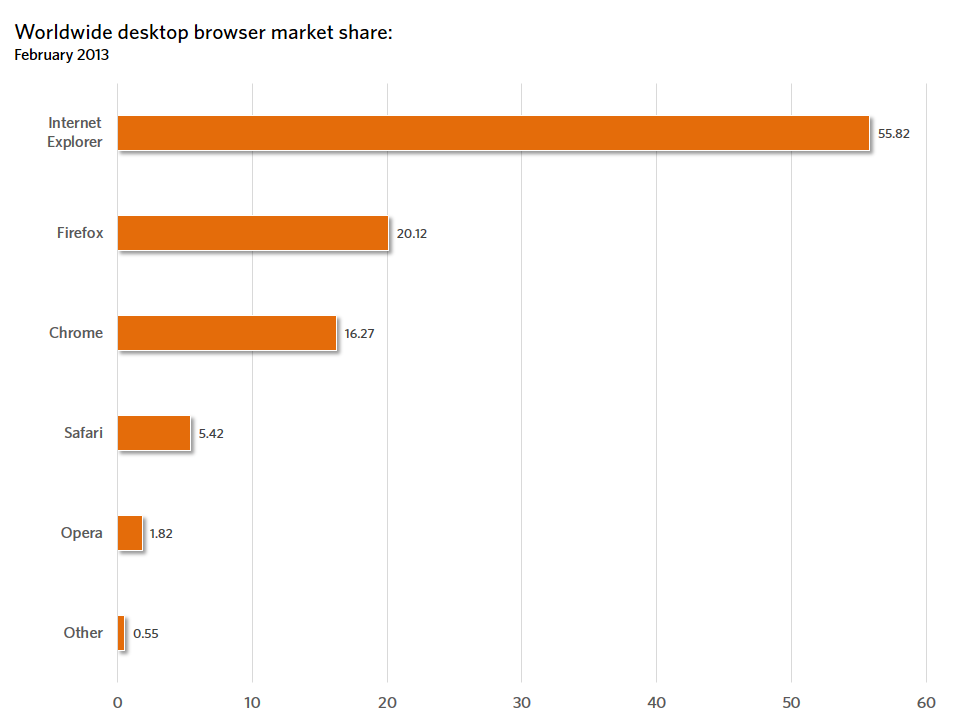
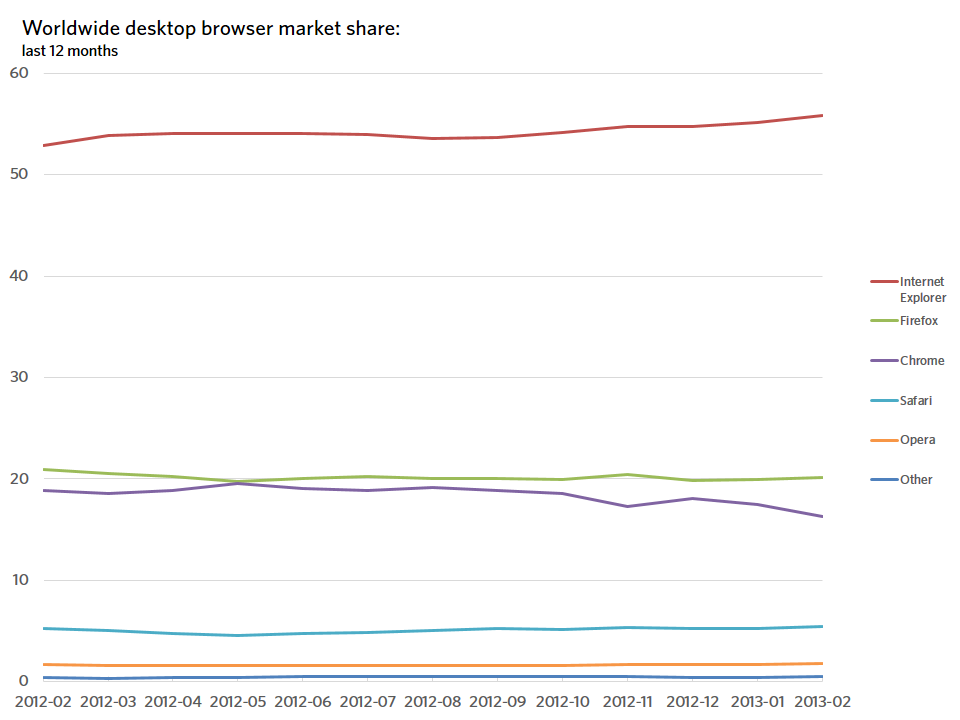
Microsoft's browser did as well as Google's browser did badly in February. Internet Explorer's share is the highest it's been in a year and a half. Chrome's is the lowest it's been in almost as long.


Internet Explorer was up 0.68 points to 55.82 percent. Firefox was back up above 20 percent, growing 0.18 points to 20.12 percent. Chrome was down sharply, losing a surprising 1.21 (giga) points, for a share of 16.27 percent. Safari and Opera were both up slightly, with gains of 0.18 and 0.07 points for a total of 5.42 and 1.82 percent, respectively

Friday, March 8, 2013

Find: Improve your App Engine skills with Google Developers Academy

Improve your App Engine skills with Google Developers Academy

Author PhotoBy Wesley Chun, Developer Relations Team

Cross-posted with the Google App Engine Blog

Are you developing on App Engine today or interested in learning how to use it? If you've gone through all the great App Engine docs and Getting Started tutorials (Python, Java, or Go) but want to take your App Engine skills a step further, then Google Developers Academy (GDA) is the place to go! We launched GDA this past summer at Google I/O 2012, with content for beginners as well as seasoned developers. What can you find on App Engine in GDA today?

computers in a classroom

If you’re interested in getting more background on what cloud computing is and where App Engine fits into that ecosystem, then this intro class (Introduction to Google App Engine) is for you. Once you’re done with this class, you’ll be ready to tackle the Getting Started tutorial, and after that, move on to the App Engine 101 in Python class.

While some of the material found in App Engine 101 is similar to what's in the Getting Started tutorial, the 101 class targets developers who skipped the tutorial or completed it at some point in the past but don't want to repeat the exact same thing. The main differences include the following changes to the tutorial's content:

  • Use of the Python NDB API

  • Jinja2 templates

  • Discussion of data consistency and datastore indexes

You can use the relational MySQL-compatible Google Cloud SQL service as an alternative to App Engine's native non-relational...

Wednesday, November 21, 2012

Find: Google rallies opposition to UN takeover of Internet governance

Google rallies opposition to UN takeover of Internet governance

The world's leading search company has decided to come out swinging against an effort by the International Telecommunications Union (ITU), the telecommunications arm of the United Nations, to seize a larger role for itself in Internet governance.

"There is a growing backlash on Internet freedom," Google says on its website. "Forty-two countries filter and censor content. In just the last two years, governments have enacted 19 new laws threatening online free expression."

Google worries that these censorious governments could use the upcoming World Conference on International Telecommunications, which starts December 3, as an opportunity to grab more authority over the Internet. "The ITU is the wrong place to make decisions about the future of the Internet," Google argues.

Saturday, November 10, 2012

Find: GDL Presents - Women Techmakers

Find: Get started at no cost with a faster, larger Cloud SQL database

Free 100gb MySQL DBs on google. 

Get started at no cost with a faster, larger Cloud SQL database

Author Photo
By Joe Faith, Product Manager

Cross-posted with the Official Google Enterprise Blog

You want your applications to be fast, even with millions of users. Anytime your user tries to retrieve information from the app or update settings, it should happen instantly. For the best performance, you need faster, larger databases - especially if you have a growing user base to serve.

Google App Engine is designed to scale. And now Google Cloud SQL—a MySQL database that lives in Google’s cloud—has new features to meet the demand for faster access to more data. With today’s updates, you can now work with bigger, faster MySQL databases in the cloud:


  • More Storage: We’re increasing the available storage on Cloud SQL to 100GB – ten times more than what used to be available.

  • Faster Reads: We’re increasing the maximum size of instances to 16GB RAM, a 4 times increase in the amount of data you can cache.


  • Faster Writes: We’re adding functionality for optional asynchronous replication, which gives the write performance of a non-replicated database, but the availability of a replicated one.


  • EU datacenter availability: Now you can choose to store your data and run your Cloud SQL database instance in either our US or EU data centers.

  • Integration with Google Apps Script: We’re making it quick and easy for businesses using Google Apps to use Cloud SQL. Publish and share data with Google Sheets, add data to Google Sites pages or create simple Google Forms without worrying about hosting or configuring servers. 


Introducing a new trial offer 

Many of you have requested a trial offer to test out Cloud SQL. Today, we’re introducing a 6- month trial offer at no charge, effective until June 1, 2013. This will include one Cloud SQL instance with 0.5 GB of storage. Sign up now and get started on Cloud SQL at no cost.

Joe Faith is a Product Manager on the Google Cloud Team. In a previous life he was a researcher in machine learning, bioinformatics, and information visualization, and was founder of charity fundraising site Fundraising Skills.

Posted by

Tuesday, October 16, 2012

Find: Google's bid to fix Javascript, Dart, is ready for the real world

Google's bid to fix Javascript, Dart, is ready for the real world

A year ago, Google unveiled a programming language called Dart in an attempt to fix what’s wrong with JavaScript. The hope was to eventually “replace JavaScript as the lingua franca of Web development."

At the time, it was just a technology preview, more useful for people interested in developing Dart itself than for those interested in developing applications with Dart. That’s not to say developers couldn’t build with Dart, but the language needed a complete set of development tools to get a sniff of the mainstream. And that’s exactly what Google delivered today, with what it calls the “first developer-oriented version of the Dart SDK.”

The key improvements and features, according to Google software engineer Lars Bak, are as follows:

Thursday, October 11, 2012

Find: Security breach briefly hijacks connections to Google.ie and Yahoo.ie

Security breach briefly hijacks connections to Google.ie and Yahoo.ie.

The outfit that manages Internet addresses for Ireland’s national .ie domain has temporarily taken some of its systems offline while officials investigate a security breach that temporarily hijacked the Irish websites for Google and Yahoo.


A short note on the homepage of the IE Domain Registry said the move followed a "security incident on Tuesday 9th October, involving two high profile .ie domains that has warranted further investigation and some precautionary actions on the part of the IEDR." Several independent Web posts, including those on Twitter and the site of a .ie domain registrar (Google cache here) identified the sites as Google.ie and Yahoo.ie. People trying to visit those addresses were briefly redirected to a fraudulent server as a result of "unauthorised access to one Registrar's account which resulted in the change to the DNS nameserver records for the two .ie domains," the latter blog post reported, citing IEDR CEO David Curtin.


Both of the affected sites, according to whois records, are managed by MarkMonitor, a company that protects the online brands of its customers. Sophos security expert Graham Cluley reported that the breach caused the IEDR to incorrectly point users to domain name system name servers at farahatz.net, which appear to be located in Indonesia.

Tuesday, October 9, 2012

Find: Apple, Microsoft, Google, and others team up to support standards site Web Platform Docs

Looks useful!

Apple, Microsoft, Google, and others team up to support standards site Web Platform Docs

WebPlatform.org Logo

Web development has become increasingly complex in recent years, and now a new website has launched — with the backing of several major industry players — in an effort to become the definitive resource for developers looking to explore web standards. Web Platform Docs, which launched today in a self-described "alpha" form, wants to become "the place to come for answers to your trickiest (and simplest) development and design questions about the Open Web Platform." The project is backed by the World Wide Web Consortium (W3C) standards body, as well as the likes of Apple, Google, Microsoft, Facebook, Mozilla, Nokia, and others.

The site currently consists of a wiki, forums, a chat channel, and a blog, but the ambitions run much...

Thursday, September 27, 2012

Find: 500 Chrome Experiments and counting...

500 Chrome Experiments and counting...

The web is capable of amazing things and is becoming more capable all the time. To show some of the potential of a better web, we launched ChromeExperiments.com in March 2009 with 19 inspiring examples by the creative coding community of what’s possible when combining the latest web technologies with a little code and imagination. Some of those original experiments, like Google Gravity and Ball Pool, are still popular today. But we’re pleased to say that they’ve since been joined by hundreds of other contributions from around that world that have pushed the web even further.

Today marks our 500th experiment, and in celebration, we created Experiment 500 as a thank you note to everyone who submitted their work to the site. It’s an array of interactive particles, each one of them corresponding to a different submission. You can sort them by date or by category.

Celebrating 500 Chrome Experiments

As you browse the experiments, you’ll notice that Chrome Experiments has evolved along with the web in the last 3.5 years. After Google Chrome added support for WebGL, for example, we started seeing beautiful 3D graphics experiments like Evan Wallace’s WebGL Water Simulation and HelloEnjoy’s Lights. When Web Audio came out, we received experiments that let users compose music together, such as Brandon Lockaby’s Multiplayer Piano and Dinahmoe’s Plink. This summer, with the release of Chrome for Android and iOS, we also announced a new gallery of mobile experiments, with submissions including AlteredQualia’s Multitouch Toy and Dominic Szablewski’s X-Type. Lately, we’ve seen real-...

Friday, September 21, 2012

Find: Build apps for elections with the Google Civic Information API

Google Code Blog Build apps for elections with the Google Civic Information API

Author Photo
By Chetan Sabnis, Google Politics & Elections Team

Cross-posted from the Google Politics & Elections Blog

Google’s mission is to organize the world’s information and make it universally accessible and useful. To make it easier for you to build apps with voting information on the web, we are releasing our new Google Civic Information API. The API enables you to look up comprehensive voting information for an individual U.S. address, including polling place, early vote sites, contests, and local election official contact information. By releasing this API, we hope to unleash the creativity of the Internet and help you build innovative products that push civic information to your communities in interesting ways.

As you know, this type of information can change frequently as we get closer to Election Day, and we will make every effort to ensure we're returning timely and accurate data. We have also included contact information for local election officials in the API so voters can find the most accurate information.

#more 

While this API only includes voting information for elections in the U.S., we plan to expand to other countries and include other types of civic information. Please join the Google Civic Information API Forum for updates on the data available and check out the Google Politics & Elections page to find more information about the work we are doing around the election and our international elections programs.


You can get started here through the Google APIs Explorer. The API is available now, but please note that full information isn't yet available for the November 6th General Election. We expect to be able to provide full live data around the middle of October, as it becomes available. For now, we recommend building your applications using the test data we provide. We'll be using the API to power our own election tools over the coming weeks, including an embeddable app anyone can use on their site, and we're looking forward to seeing the applications you come up with!

The Civic Information API replaces our previous Google Election Center API, which will be turned down after January 1, 2013.

For questions, comments, and to showcase your apps using the API, we encourage you to use the Google Civic Information API Forum.


Chetan Sabnis is a software engineer on the Google Politics & Elections team. In his spare time, Chetan enjoys solving logic puzzles and crosswords.

Posted by Scott Knaster, Editor
Thursday, September 13, 2012

Spotted: Users love simple and familiar designs – Why websites need to make a great first impression

In other settings, visual complexity is more aesthetic, not less. 

___

Users love simple and familiar designs – Why websites need to make a great first impression

Posted by Javier Bargas-Avila, Senior User Experience Researcher at YouTube UX Research
I’m sure you’ve experienced this at some point: You click on a link to a website, and after a quick glance you already know you’re not interested, so you click ‘back’ and head elsewhere. How did you make that snap judgment? Did you really read and process enough information to know that this website wasn’t what you were looking for? Or was it something more immediate?
We form first impressions of the people and things we encounter in our daily lives in an extraordinarily short timeframe. We know the first impression a website’s design creates is crucial in capturing users’ interest. In less than 50 milliseconds, users build an initial “gut feeling” that helps them decide whether they’ll stay or leave. This first impression depends on many factors: structure, colors, spacing, symmetry, amount of text, fonts, and more.
In our study we investigated how users' first impressions of websites are influenced by two design factors:
  1. Visual complexity -- how complex the visual design of a website looks 


  • Prototypicality -- how representative a design looks for a certain category of websites
  • We presented screenshots of existing websites that varied in both of these factors -- visual complexity and prototypicality -- and asked users to rate their beauty.

    The results show that both visual complexity and prototypicality play crucial roles in the process of forming an aesthetic judgment. It happens within incredibly short timeframes between 17 and 50 milliseconds. By comparison, the average blink of an eye takes 100 to 400 milliseconds.
    And these two factors are interrelated: if the visual complexity of a website is high, users perceive it as less beautiful, even if the design is familiar. And if the design is unfamiliar -- i.e., the site has low prototypicality -- users judge it as uglier, even if it’s simple.


    In other words, users strongly prefer website designs that look both simple (low complexity) and familiar (high prototypicality). That means if you’re designing a website, you’ll want to consider both factors. Designs that contradict what users typically expect of a website may hurt users’ first impression and damage their expectations.


    Sunday, September 9, 2012

    Find: Indystate by netapp - Chrome growth picks up

    Chrome growth picks up; Windows 7 becomes the world's most used OS


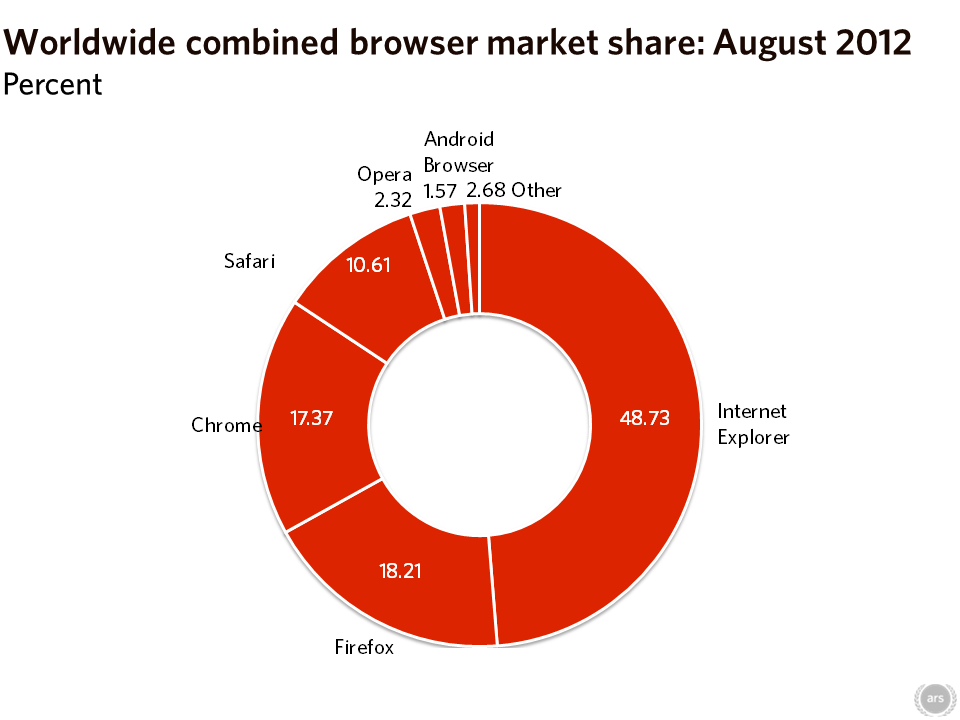
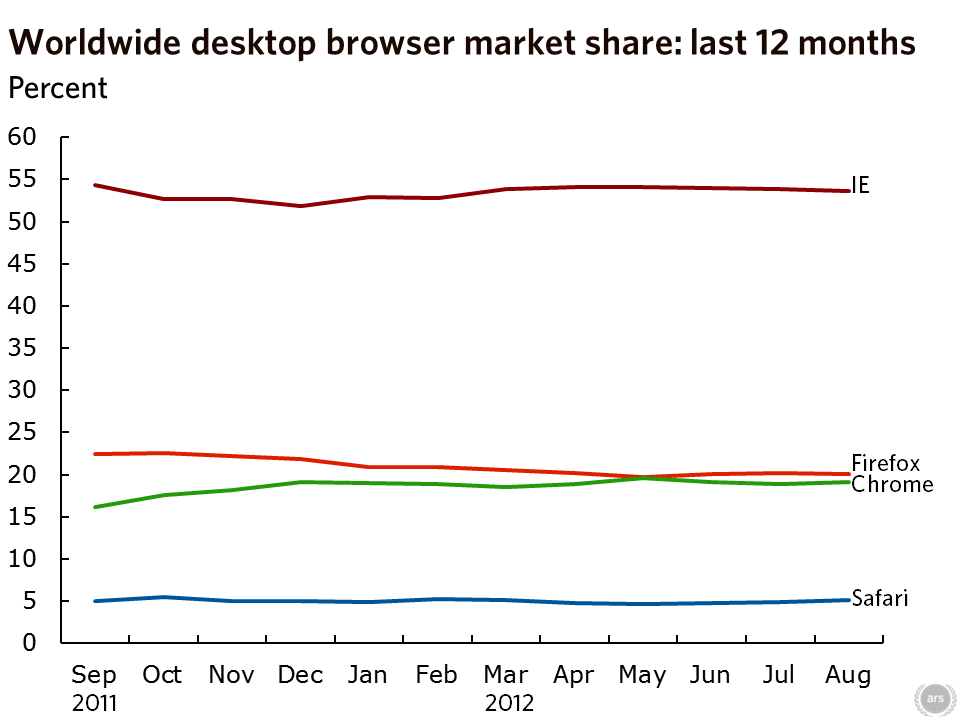
    The last few months have seen Chrome poised to overtake Firefox as the second most widely used browser, and Windows 7 on the cusp of overtaking Windows XP to become the most popular operating system. For a long time it looked as if Chrome would win its race first, but in June and July its market share declined, allowing Firefox to strengthen its lead.

    In August, Chrome resumed its gains, but didn't grow enough to leapfrog Firefox. Windows 7, however, has at long last overtaken the 11-year-old Windows XP—in the same month that its successor, Windows 8, made its way to the first end-user systems.


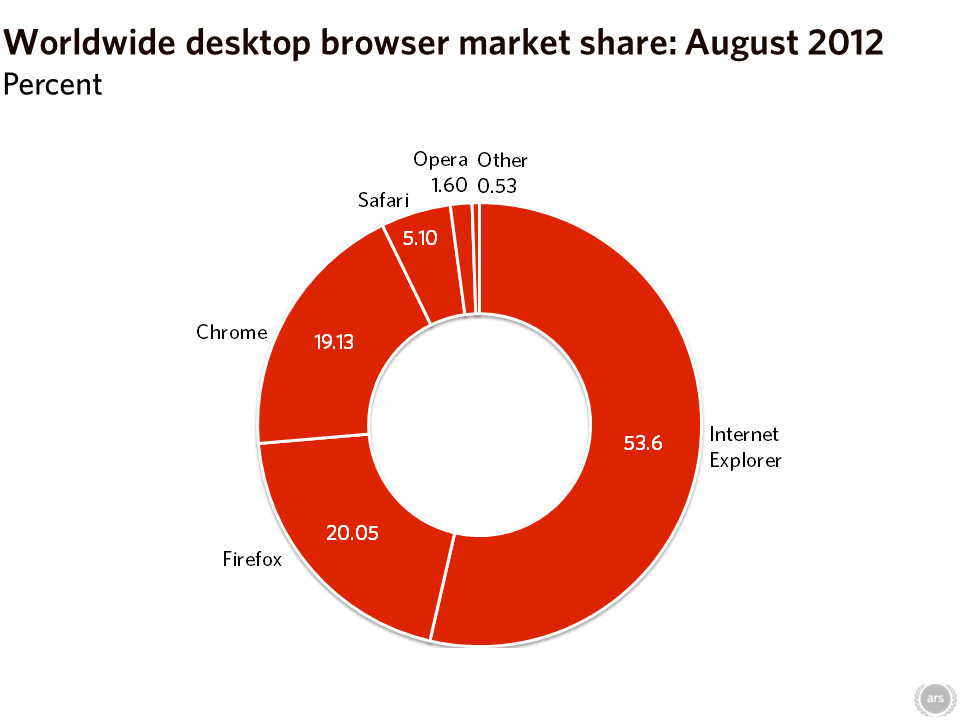
    Internet Explorer is down 0.3 points to 53.6 percent. Firefox dropped 0.15 points to 20.05 percent. Chrome picked up 0.23 points to 19.13 percent. Safari gained 0.2 points to 5.1 percent, while Opera was essentially unchanged, down 0.01 points to 1.58 percent.

    Wednesday, August 15, 2012

    Find: Leak Finder - a new tool for JavaScript

    Leak Finder: a new tool for JavaScript

    Leak finder for JavaScript helps web application developers find memory leaks in their JavaScript programs.

    In garbage-collected languages, such as JavaScript, you cannot have traditional memory leaks by forgetting to free memory: when all references to an object are dropped, the object is garbage-collected and the memory is freed.

    However, JavaScript programs can leak memory by unintentionally retaining references to objects. For example the references can be pointers to objects stored in a data structure in a JavaScript library (e.g., Closure) instead of the application code. If an object is unintentionally retained, all objects it points to are kept alive as well. This will lead to superfluous memory consumption.

    Find: visualizing the evolution of the web

    Behind the scenes: visualizing the evolution of the web

    Dero

    Sergio

    This guest post is by Sergio Alvarez, Vizzuality, and Deroy Peraza, Hyperakt, in collaboration with Min Li Chan, Chrome Team

    At Google I/O this year, we launched a new version of The Evolution of the Web, a project visualizing the history and pace of innovation in web technologies and browsers. The Evolution of the Web traces how web technologies have evolved in the last two decades and highlights the web community’s continuous efforts to improve the web platform and enable developers to create new generations of immersive web experiences. In collaboration with the Google Chrome team, the team at Hyperakt designed the interactive visualization while Vizzuality built it using HTML5, SVG, and CSS3.

    The visualization included 43 web technology "strands" across 7 browser timelines to represent major developments on the web platform. On hover or tap, each strand is highlighted to reveal intersections that tell the story of when browser support was implemented for each new web technology. To provide additional context, we developed a secondary visualization to illustrate the growth of Internet users and traffic.

    Find: Access Google APIs with Dart

    Dart is google's js replacement. 

    Access Google APIs with Dart

    Author PhotoBy Sam McCall, Software Engineer

    Ever since we launched Dart, the structured web programming language, we've heard developers asking for a way to use Dart to connect to Google's most popular APIs and services. Thanks to Google's 20% time policy, I’m working on an open source library that helps Dart developers connect to Google APIs such as Google+, YouTube, URL Shortener, and many more.

    My favorite sample showing you how to build web apps with Dart and Google APIs is roulette. This little app will shorten your URL, or if you're lucky, rickroll you.

    This library is currently alpha and under active development. Please report all bugs in the issue tracker and ask questions in the discussion forum. Thanks for the feedback, and have fun!

    Sam McCall is an engineer in Google’s Corporate Engineering Team in Munich, and is a part-time Dart tinkerer.

    Posted by Scott Knaster, Editor

    Tuesday, August 7, 2012

    Find: Introducing new Fusion Tables API

    Introducing new Fusion Tables API

    By Warren Shen, Google Fusion Tables team

    Amidst all the excitement of I/O followed by the July 4th holiday in the U.S., many developers missed the announcement of the new Fusion Tables API. The new API includes all of the functionality of the existing SQL API, plus the ability to read and modify table and column metadata as well as the definitions of styles and templates for data visualization. This API is also integrated with the Google APIs console which lets developers manage all their Google APIs in one place and take advantage of built-in reporting and authentication features.

    With this launch, we are also announcing a six month deprecation period for the existing SQL API. Since the new API includes all of the functionality of the existing SQL API, developers can easily migrate their applications using our migration guide.

    For a detailed description of the features in the new API, please refer to the API documentation.

    Posted by Ashleigh Rentz, Editor Emerita

    Find: Measure and optimize with mod_pagespeed experiments

    Measure and optimize with mod_pagespeed experiments

    Author Photo
    By Jeff Kaufman, Software Engineer, PageSpeed Team


    Making your site fast shouldn’t require lots of manual optimization. With mod_pagespeed, an open-source Apache module, you can automatically apply web performance optimization best practices like cache extension, image optimization, and css inlining to speed up your site without a lot of hassle. As of version 0.10.22.4, mod_pagespeed now supports A/B tests integrated with Google Analytics, allowing you to measure how much it speeds up your site on live traffic and experimentally determine the best settings.

    When running an experiment, mod_pagespeed randomly assigns visitors to experimental configurations based on percentages you choose. You can run an experiment on 1% of your traffic, 100%, or anywhere in between without affecting other visitors. It also injects JavaScript to report experiment assignments back to your Google Analytics account in a custom variable. Within Analytics you can track the impact of experimental configurations on page load times, bounce rates, conversions, or any other Analytics metric.

    We ran an example experiment, comparing mod_pagespeed running with default settings to mod_pagespeed in pass-through mode, on a small blog. This required adding the following lines to our pagespeed.conf:

    ModPagespeedRunExperiment on ModPagespeedAnalyticsID "UA-XXXXXXXX-Y" # half the users get the pagespeed optimizations ModPagespeedExperimentSpec id=3;percent=50;default # half get an unoptimized site ModPagespeedExperimentSpec id=4;percent=50
    While this site was static and contained mostly text, it did use some JavaScript and images and had not been manually optimized. We ran the experiment for a month, over which Analytics observed 11K page views, and we saw a 20% improvement in average page load time:

    Competition: Google Places API Developer Challenge 2012

    Deadline 10/31

    The power of places and big data for good: Google Places API Developer Challenge 2012

    Author Picture
    By Carlos Cuesta, Google Maps API Product Marketing Manager

    Cross-posted with the Google Geo Developers Blog

    How would you make your community or local government run better? In our first Google Places API Developer Challenge, we’re inviting developers around the world to make something that improves their communities or governments by using the Google Places API and its database of places and tools. The developers of the winning applications will receive a VIP experience at Google I/O 2013.

    You might create an app or site that solves health problems, understands crime patterns, or improves commerce. You can use any platform as long as you build with the Google Places API and it benefits your community or government. We’re looking for your best and most innovative ideas.


    Built on the comprehensive global database of more than 95 million places that powers Google Maps, the Google Places API enables you to search for information about a variety of nearby places such as establishments, geographic locations and prominent points of interest. You can re-rank place results based on user check-ins, and create new places specific to your app.

    To help you develop your ideas and build better apps, we’ve been working with local government officials in Austin, Boston, Chicago, London, Louisville, New York City, Philadelphia, Portland, San Francisco, and Seattle along with the White House to surface a wide variety of data sets for your apps. You can find these data sets and more on the Google Places API Challenge site at http://developers.google.com/challenge and hear more about what cities have to say about the challenge here. You can also follow updates and hangouts about the challenge on +Google Maps API.

    The submission window opens on August 15th and closes on October 31st, 2012.

    We look forward to seeing what can happen when your imagination and the Google Places API come together!