Showing posts with label twitter. Show all posts

Tuesday, February 19, 2013

Find: Facebook, Twitter, Apple hack sprung from iPhone developer forum
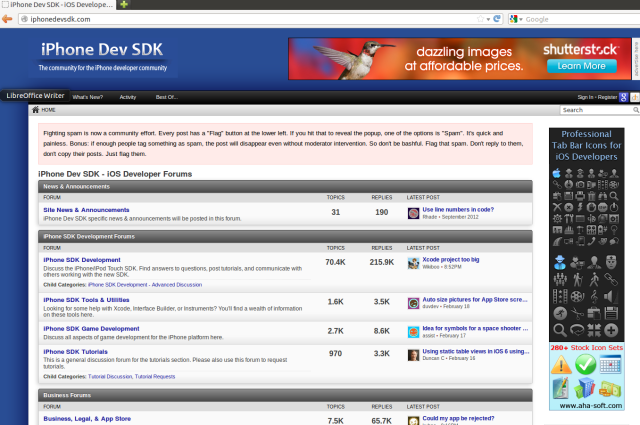
Watering hole attack on the big guys uses a zero day java exploit. 

---

Facebook, Twitter, Apple hack sprung from iPhone developer forum


iPhone Dev SDK, the web forum that was at the center of the hack of Facebook and other companies in January.


The website used to infect engineers at Facebook with espionage malware has been identified as an iPhone developer forum by people close to the investigation into the hacking incident.


That page, at the iPhone developer website iphonedevsdk.com, was used to expose visitors to a previously undocumented vulnerability in Oracle's Java browser plugin. The "zero-day" exploit allowed the attackers to install a collection of malware on the Java-enabled computers of those who visited the site. Ars readers shouldn't visit the site because it still may still be compromised.


iphonedevsdk.com is an example of a "watering hole" attack. These attacks compromise a site popular with a population of desired hacking victims, using security vulnerabilities to install code on the Web server hosting it, which injects attacks into the HTML sent to its visitors. In this case, the site, which hosts a Web forum for iPhone developers, netted the hackers access to the computers of software engineers and developers working on mobile application projects for a number of companies, including Facebook. The exploit was the source of the attack on Twitter that led to the theft of Twitter usernames and passwords, according to a source familiar with the attack, and was used to infect computers belonging to Apple engineers. The source requested anonymity because he was not authorized to provide the details to the press.

Wednesday, August 15, 2012

Find: The Tech Behind the New Twitter.com

The Tech Behind the New Twitter.com

The Twitter.com redesign presented an opportunity to make bold changes to the underlying technology of the website. With this in mind, we began implementing a new architecture almost entirely in JavaScript. We put special emphasis on ease of development, extensibility, and performance. Building the application on the client forced us to come up with unique solutions to bring our product to life, a few of which we’d like to highlight in this overview

Find: Improving Browser Security with CSP

Improving Browser Security with CSP

If you are using Firefox 4, you now have an extra layer of security when accessing mobile.twitter.com.

Over the past few weeks we've been testing a new security feature for our mobile site. It is called a Content Security Policy, or CSP. This policy is a standard developed by Mozilla that aims to thwart cross site scripting (XSS) attacks at their point of execution, the browser. The upcoming release of Firefox 4 implements CSP, and while the mobile site may not get a high volume of desktop browser traffic (the desktop users hitting that site typically have low bandwidth connections), it has given us an opportunity to test out a potentially powerful anti-XSS tool in a controlled setting.

CSP IN A NUTSHELL

In a typical XSS attack, the attacker injects arbitrary Javascript into a page, which is then executed by an end-user. When a website enables CSP, the browser ignores inline Javascript and only loads external assets from a set of whitelisted sites. Enabling CSP on our site was simply a matter of including the policy in the returned headers under the CSP defined key, 'X-Content-Security-Policy'.

The policy also contains a 'reporting URI' to which the browser sends JSON reports of any violations. This feature not only assists debugging of the CSP rules, it also has the potential to alert a site’s owner to emerging threats.

Find: Twitter’s mobile web app delivers performance

Twitter’s mobile web app delivers performance

As the number of people using Twitter has grown, we've wanted to make sure that we deliver the best possible experience to users, regardless of platform or device. Since twitter.com is not optimized for smaller screens or touch interactions familiar to many smart phones, we decided to build a cross-platform web application that felt native in its responsiveness and speed for those who prefer accessing Twitter on their phone's or the tablet’s browser.

A better mobile user experience

When building mobile.twitter.com as a web client, we used many of the tools offered in HTML5, CSS3, and JavaScript to develop an application that has the same look, feel, and performance of a native mobile application. This post focuses on four primary areas of the mobile app architecture that enabled us to meet our performance and usability goals:


  • event listeners

  • scroll views

  • templates

  • storage

  • Twitter's mobile app architecture

Cassovary: A Big Graph-Processing Library

Cassovary: A Big Graph-Processing Library

We are open sourcing Cassovary, a big graph-processing library for the Java Virtual Machine (JVM) written in Scala. Cassovary is designed from the ground up to efficiently handle graphs with billions of edges. It comes with some common node and graph data structures and traversal algorithms. A typical usage is to do large-scale graph mining and analysis.


At Twitter, Cassovary forms the bottom layer of a stack that we use to power many of our graph-based features, including "Who to Follow" and “Similar to.” We also use it for relevance in Twitter Search and the algorithms that determine which Promoted Products users will see. Over time, we hope to bring more non-proprietary logic from some of those product features into Cassovary.


Please use, fork, and contribute to Cassovary if you can. If you have any questions, ask on the mailing list or file issues on GitHub. Also, follow @cassovary for updates.


-Pankaj Gupta (@pankaj)

Find: MySQL at Twitter

MySQL at Twitter

MySQL is the persistent storage technology behind most Twitter data: the interest graph, timelines, user data and the Tweets themselves. Due to our scale, we push MySQL a lot further than most companies. Of course, MySQL is open source software, so we have the ability to change it to suit our needs. Since we believe in sharing knowledge and that open source software facilitates innovation, we have decided to open source our MySQL work on GitHub under the BSD New license.

The objectives of our work thus far has primarily been to improve the predictability of our services and make our lives easier. Some of the work we’ve done includes:

  • Add additional status variables, particularly from the internals of InnoDB. This allows us to monitor our systems more effectively and understand their behavior better when handling production workloads.
  • Optimize memory allocation on large NUMA systems: Allocate InnoDB's buffer pool fully on startup, fail fast if memory is not available, ensure performance over time even when server is under memory pressure.
  • Reduce unnecessary work through improved server-side statement timeout support. This allows the server to proactively cancel queries that run longer than a millisecond-granularity timeout.
  • Export and restore InnoDB buffer pool in using a safe and lightweight method. This enables us to build tools to support rolling restarts of our services with minimal pain.
  • Optimize MySQL for SSD-based machines, including page-flushing behavior and reduction in writes to disk to improve lifespan.
We look forward sharing our work with upstream and other downstream MySQL vendors, with a goal to improve the MySQL community. For a more complete look at our work, please see the change history and documentation.

If you want to learn more about our usage of MySQL, we will be speaking about Gizzard, our sharding and replication framework on top of MySQL, at the Percona Live MySQL Conference and Expo on April 12th. Finally, contact us on GitHub or file an issue if you have questions.

On behalf of the Twitter DBA and DB development teams,

- Jeremy Cole (@jeremycole)

- Davi Arnaut (@darnaut)

Find: TwitterCLDR - Improving Internationalization Support in Ruby

TwitterCLDR: Improving Internationalization Support in Ruby

We recently open sourced TwitterCLDR under the Apache Public License 2.0. TwitterCLDR is an “ICU level” internationalization library for Ruby that supports dates, times, numbers, currencies, world languages, sorting, text normalization, time spans, plurals, and unicode code point data. By sharing our code with the community we hope to collaborate together and improve internationalization support for websites all over the world. If your company is considering supporting multiple languages, then you can try TwitterCLDR to help your internationalization efforts.

Motivation

Here’s a test. Say this date out loud: 2/1/2012
If you said, “February first, 2012”, you’re probably an American. If you said, “January second, 2012”, you’re probably of European or possibly Asian descent. If you said, “January 12, 1902”, you’re probably a computer. The point is that as humans, we almost never think about formatting dates, plurals, lists, and the like. If you’re creating a platform available around the world, however, these kinds of minutiae make a big difference to users.
The Unicode Consortium publishes and maintains a bunch of data regarding formatting dates, numbers, lists, and more, called the Common Locale Data Repository (CLDR). IBM maintains International Components for Unicode (ICU), a library that uses the Unicode Consortium’s data to make it easier for programmers to use. However, this library is targeted at Java and C/C++ developers and not Ruby programmers, which is one of the programming languages used at Twitter. For example, Ruby and TwitterCLDR helps power our Translation Center. TwitterCLDR provides a way to use the same CLDR data that Java uses, but in a Ruby environment. Hence, formatting dates, times, numbers, currencies and plurals should now be much easier for the typical Rubyist. Let’s go over some real world examples.